Cross-Border Data Transfer Under GDPR: Complete Guide

- Published:
- Last Updated:
Cross-Border Data Transfer Under GDPR occurs when personal data is sent or made accessible to an organization outside the European Economic Area. Organizations must choose a valid transfer mechanism, assess possible risks, apply suitable safeguards, maintain proper records, and regularly review how international data transfers are managed.
Overview
Businesses regularly transfer personal data through global cloud platforms, overseas vendors, international offices, SaaS applications, payroll systems, and customer-support providers. GDPR requires organizations to ensure that personal data remains protected even after it leaves the European Economic Area.
The international movement of personal data by global organizations is also discussed in InCountry Staff. “Guide to the Cross-Border Transfer of Personal Data for Global Companies.” InCountry, April 25, 2023.
Key Findings
- GDPR Chapter V governs international data transfers.
- Organizations must use a valid transfer mechanism.
- SCCs may require a Transfer Impact Assessment.
- Technical and contractual safeguards may be necessary.
- Employee awareness helps prevent unauthorized transfers.
- Transfer records should be reviewed regularly.
What Is a Cross-Border Data Transfer Under GDPR?
Cross-border data transfer means sending, storing, processing, or allowing access to personal data outside the European Economic Area. This includes storing information on overseas cloud servers, sharing employee data with global payroll providers, allowing foreign vendors to access customer records, using international SaaS or analytics platforms, sharing data between multinational group companies, or providing overseas support teams with system access.
The organization sending the personal data is known as the data exporter, while the overseas recipient is called the data importer. Guidance on international transfer regulations and organizational responsibilities is also covered in Shaikh, Sarfaraz. “Cross Border Data Transfer Regulations: What You Need to Know?” Privacy Pillar, June 18, 2024. Remote access may also be considered an international transfer when a separate organization located outside the EEA can view, access, or process the personal data.
What GDPR Transfer Mechanisms Can Organizations Use?
GDPR provides several legal mechanisms for transferring personal data internationally.
The main mechanisms include:
- Adequacy Decisions – Used when the destination offers an officially recognized level of data protection.
- Standard Contractual Clauses – Approved contractual protections used when no adequacy decision applies.
- Binding Corporate Rules – Approved rules for transfers within multinational groups.
- Codes of Conduct – Approved industry rules supported by binding commitments.
- Certification Mechanisms – Approved certifications with enforceable data-protection duties.
- Article 49 Derogations – Limited exceptions for specific situations.
The legal and operational difficulties involved in selecting and managing these safeguards are examined in Infotel UK Consulting. “GDPR and the Challenge of Cross-Border Data Transfers.” n.d.
How Do Legitimate GDPR Data Transfers Work?
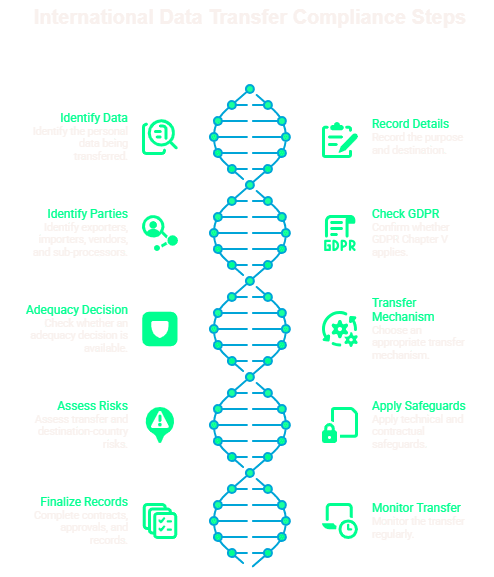
Legitimate transfers require a clear process that combines legal, security, governance, and monitoring activities.
Organizations should follow these steps:
- 1.Identify the personal data being transferred.
- 2.Record the purpose and destination.
- 3.Identify exporters, importers, vendors, and sub-processors.
- 4.Confirm whether GDPR Chapter V applies.
- 5.Check whether an adequacy decision is available.
- 6.Choose an appropriate transfer mechanism.
- 7.Assess transfer and destination-country risks.
- 8.Apply technical and contractual safeguards.
- 9.Complete contracts, approvals, and records.
- 10.Monitor the transfer regularly.
Read more: Data Inventory for DPDP Compliance
What Is a Transfer Impact Assessment?
Transfer Impact Assessment evaluates whether personal data can receive effective protection in the destination country.
TIA commonly reviews:
- Type and sensitivity of data
- Purpose and frequency of the transfer
- Destination-country laws
- Government-access risks
- Recipient security practices
- Available legal remedies
- Sub-processors and onward transfers
- Encryption and pseudonymization
- Need for additional safeguards
What Are Standard Contractual Clauses?
Standard Contractual Clauses are approved contractual terms used to protect personal data transferred to countries without an applicable adequacy decision.
SCCs cover four relationships:
- Controller to controller
- Controller to processor
- Processor to processor
- Processor to controller
Organizations must choose the correct module and complete all required details accurately. The clauses should describe the data, processing purpose, recipients, security controls, and sub-processors.
Signing SCCs alone may not be enough. Organizations should also assess transfer risks, review onward transfers, apply additional safeguards, and monitor important changes.
Read also: What Is the Data Minimization Principle?
What Are the Common GDPR Transfer Compliance Pitfalls?
Common failures occur when organizations treat international transfers as paperwork instead of ongoing compliance activities.
Organizations should avoid:
- Using the wrong transfer mechanism
- Selecting the wrong SCC module
- Completing SCC details incorrectly
- Ignoring overseas remote access
- Failing to identify sub-processors
- Overlooking onward transfers
- Using derogations for regular transfers
- Transferring unnecessary personal data
- Not updating transfer assessments
- Providing insufficient employee training
- Maintaining weak compliance evidence
Read more: Data Discovery Under the DPDP Act
What Are the Main Risks of GDPR Cross-Border Transfers?
International transfers can create legal, privacy, security, operational, and reputational risks.
Major risks include:
- Limited visibility of data locations
- Unauthorized access
- Government-access exposure
- Weak vendor security controls
- Excessive data sharing
- Poor encryption or key management
- Uncontrolled onward transfers
- Employee use of unapproved tools
- Data breaches
- Regulatory action
- Customer complaints
- Reputational damage
What Additional Safeguards Are Needed for Cross-Border Data Transfers?
Supplementary measures help strengthen the protection of personal data transferred outside the EEA when contractual safeguards alone are not sufficient.
These measures may include:
- Encryption of data at rest and in transit.
- Pseudonymization before the transfer.
- Data minimization to limit unnecessary information.
- Strict access restrictions and role-based controls.
- Secure encryption-key management.
- Logging and continuous activity monitoring.
- Vendor audit and inspection rights.
- Clear contractual transparency obligations.
- Procedures for handling government-access requests.
Read more: Data Privacy & Security Insights Under the DPDP Act
What Is the Difference Between GDPR and DPDP Act Cross-Border Transfer Rules?
GDPR uses legal transfer mechanisms and safeguards, while the DPDP Act follows a government-restriction approach.
The key differences between GDPR and the DPDP Act are:
| Area | GDPR | DPDP Act |
|---|---|---|
| Transfer approach | Mechanism-based | Government-restriction model |
| Adequacy decisions | Recognized | No equivalent model |
| SCCs and BCRs | Recognized safeguards | Not stated as statutory mechanisms |
| Risk assessment | Transfer safeguards may need assessment | No equivalent Chapter V TIA model |
| Main terms | Controller and Processor | Data Fiduciary and Data Processor |
| Other obligations | GDPR duties continue to apply | Stricter sectoral laws may still apply |
Conclusion
Cross-border data transfers under GDPR require organizations to understand where personal data moves, apply appropriate transfer safeguards, assess third-party risks, and maintain strong security controls. Proper documentation, vendor oversight, and continuous monitoring help protect personal data and support ongoing GDPR compliance.
Explore SecuRetain’s learning platform and our all courses to build practical knowledge in cybersecurity, compliance, risk management, audit, business continuity, disaster recovery, fraud management, and employee awareness training.
You can also visit our website to explore how SecuRetain helps professionals and organizations strengthen skills, improve awareness, and support continuous learning in a structured and scalable way.
FAQ’s
It occurs when personal data is transferred or made accessible to an organization outside the European Economic Area.
Yes, provided the organization uses a valid GDPR transfer mechanism and appropriate safeguards.
They include adequacy decisions, Standard Contractual Clauses, Binding Corporate Rules, and limited Article 49 derogations.
SCCs are approved contractual safeguards used for transfers to countries without an adequacy decision.
A TIA evaluates destination-country risks and whether transferred data will receive adequate protection.
Build practical privacy and compliance capability
Explore SecuRetain’s learning platform for structured training in data protection, cybersecurity, risk, audit, and compliance.
Related reads
Keep exploring
 DPDP
DPDPLearn why data inventory for DPDP compliance is mandatory - discover personal data locations in databases, SaaS, HR systems & cloud. Complete guide to mapping, tools & audit...
 DPDP
DPDPROPA (Record of Processing Activities) is a fundamental requirement under the DPDP Act to ensure data privacy compliance. Organizations must maintain a record of how...
 DPDP
DPDPWhy data subject requests truly test your privacy program under India's DPDP Act. SEO-optimized guide covering access rights, timelines, verification, and compliance readiness...