Improve Data Security and DPDP Compliance: Steps to Secure Your Organization

- Published:
- Last Updated:
Improving data security and DPDP compliance in India is crucial for organizations handling personal data. This guide outlines essential steps like implementing employee education, using compliance automation, and ensuring lawful data processing under the DPDP Act. Key takeaways include actionable steps to secure data, ensure compliance, and protect against legal and financial risks while enhancing customer trust.
What Is the DPDP Act and Why Does It Matter?
The DPDP Act (2023) is India's primary law for personal data protection. It empowers individuals with control over their data and mandates businesses to secure personal data, establish data processing policies, and face penalties for non-compliance.
Key Objectives:
- Empower individuals with data control.
- Mandate organizations to implement data protection measures.
- Enforce penalties for violations.
- Strengthen consumer trust and legal data processing.
The DPDP Act aims to create a strong framework for personal data protection, which benefits both individuals and organizations by preventing misuse and ensuring transparency.
Read also: The Key to DPDP Compliance in an Unstructured Data World
How Does DPDP Impact Data Security?
DPDP mandates organizations to implement strict data security measures. Organizations must protect personal data from unauthorized access and breaches while ensuring compliance with data processing requirements.
| Requirement | Action |
|---|---|
| Technical Safeguards | Implement encryption, firewalls, and access controls. |
| Organizational Safeguards | Establish data governance, employee training, and access policies. |
| Maintain Records | Document all data processing activities for transparency. |
| Internal Policies Alignment | Align business policies with DPDP data protection principles. |
Key Actions:
- Implement technical and organizational safeguards
- Protect against unauthorized access, misuse, breaches, or loss
- Maintain records of data processing activities
- Align internal policies with DPDP principles
Data security is now a legal responsibility under the DPDP Act, and organizations must prioritize data protection to avoid penalties.
Read more: How Modern Discovery Tools Strengthen Privacy Programs
What Are 8 Steps to Improve Data Security and DPDP Compliance?
To strengthen data security and DPDP compliance, organizations can implement these eight practical steps, including educating employees and securing data access.
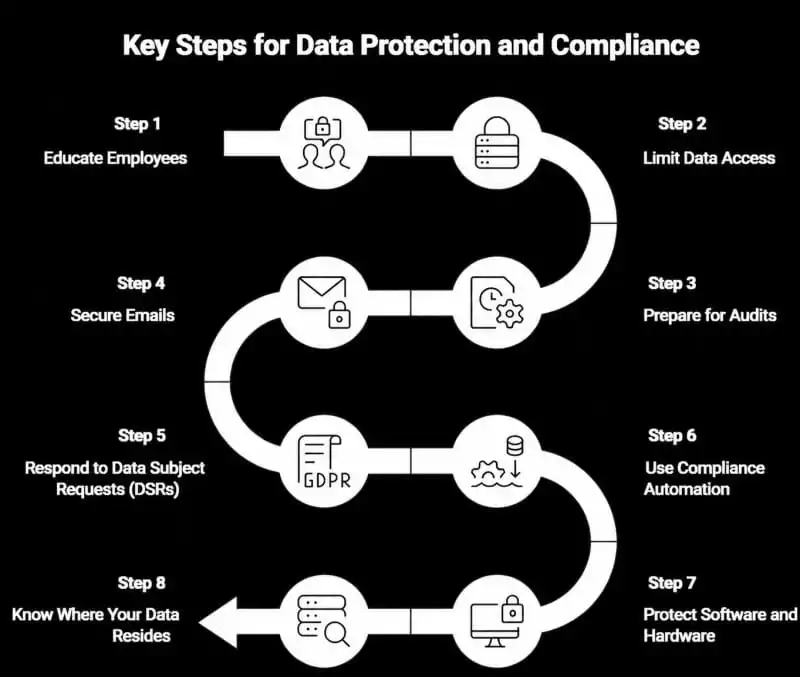
Step 1: Educate Employees
- Train staff on privacy policies and their role in data protection.
- Explain the consequences of data breaches and non-compliance.
- Increase awareness of DPDP requirements and potential risks.
Step 2: Limit Data Access
- Restrict data access to authorized personnel only.
- Use role-based access controls to minimize exposure.
- Regularly review access levels and revoke unnecessary permissions.
Step 3: Prepare for Audits
- Maintain records of data processing for audit readiness.
- Ensure availability of documentation during regulatory inspections.
- Use automated tools for efficient audit reporting.
Step 4: Secure Emails
- Encrypt sensitive emails containing personal data.
- Set up email retention policies to prevent leaks.
- Use archiving tools to ensure secure email management.
Step 5: Respond to Data Subject Requests (DSRs)
- Respond to DSRs within 30 days as per DPDP requirements.
- Maintain records of all responses and decisions.
- Ensure accurate processing of requests for access, correction, and deletion.
Step 6: Use Compliance Automation
- Automate data management and compliance tasks to minimize manual errors.
- Use tools for consent management, data tracking, and reporting.
- Ensure compliance documentation is easily accessible.
Step 7: Protect Software and Hardware
- Use encryption, firewalls, and anti-malware software.
- Secure physical devices where personal data is stored.
- Implement strict controls on removable storage devices.
Step 8: Know Where Your Data Resides
- Track where personal data is stored whether on-premises, in the cloud, or with third parties.
- Ensure accountability for all storage and transfers.
- Implement safeguards for cross-border data transfers.
Implementing these steps will not only ensure compliance with DPDP but also strengthen the overall data security posture of the organization.
Read also: What Is Personal Data Under the DPDP Act?
What is Lawful Data Processing Under DPDP?
The DPDP Act mandates that personal data can only be processed if there is a valid legal basis, including consent, contractual necessity, legal compliance, or legitimate business purposes.
Legal Bases for Data Processing:
- Consent: Obtained from the data subject.
- Contractual Necessity: Required for the performance of a contract.
- Compliance with Law: To fulfill legal obligations.
- Legitimate Business Purposes: Data processing necessary for business operations.
Non-compliance with lawful data processing can lead to penalties and reputational damage, making it critical for businesses to establish clear legal bases for processing data.
Read also: Best Online Privacy Practices for Small Businesses in India
How Does Master Data Management (MDM) Support DPDP Compliance?
MDM ensures that personal data is accurate, consistent, and compliant with DPDP by maintaining a single source of truth for data across systems. Benefits for DPDP compliance include:
- Tracking data storage locations
- Efficiently responding to DSRs
- Enforcing data retention and deletion policies
- Minimizing unauthorized access or duplication
Read also: A Complete Guide to Common Vulnerabilities and Exposures
How Does DPDP Regulate International Data Transfers?
DPDP imposes strict guidelines for cross-border data transfers, requiring adequate safeguards in the recipient country and compliance with both Indian and foreign data protection regulations.
Requirements for Data Transfer:
- Ensure appropriate safeguards are in place in the destination country.
- Assess the risks associated with international data transfers.
- Comply with both DPDP and relevant foreign regulations.
Managing cross-border data flow is complex but essential for DPDP compliance, ensuring that data privacy standards are met across jurisdictions.
Read also: DPDP and International Data Transfers
How to do Continuous Monitoring for Ongoing DPDP Compliance?
Continuous monitoring is essential for identifying risks early, enforcing data retention policies, and ensuring that personal data remains secure throughout its lifecycle.
Continuous Monitoring Tasks:
- Detecting potential data security risks early.
- Enforce data retention and deletion policies.
- Prevent unauthorized access to personal data.
Regular monitoring reduces the risk of non-compliance and helps prevent fines or reputational damage.
Read also: 8 Powerful Ways to Improve Data Security and Strengthen Compliance
Conclusion
By integrating data security measures, educating employees, automating compliance tasks, and continuously monitoring data activities, organizations can protect personal data, enhance customer trust, and avoid legal and financial risks.
To take your learning to the next level, explore our diverse selection of courses designed to help you grow professionally. Visit our Courses page to find the perfect course for your needs.
If you have any questions or need more information, our Contact Us page is the best place to reach out.
Start your journey today with SecuRetain, where we support your path to success
FAQ
DPDP compliance refers to adhering to the Digital Personal Data Protection Act in India, ensuring personal data is processed, stored, and protected legally.
Improving data security under DPDP involves implementing technical safeguards like encryption, access controls, and regular security audits.
Key steps for DPDP compliance include educating employees, securing data access, preparing for audits, and ensuring lawful data processing.
Yes, Master Data Management (MDM) ensures accurate, consistent data across systems, which is crucial for DPDP compliance and data protection.
Tracking data for DPDP compliance involves monitoring where personal data is stored, processed, and transferred, ensuring accountability across systems.
Want to operationalize this into your DPDP program?
Talk with our team to map safeguards to evidence, owners, and ongoing monitoring - so your privacy posture holds up during audits.
Related reads
Keep exploring
 DPDP
DPDPImproving data security is one of the most important steps for achieving DPDP and GDPR compliance. Learn eight smart controls, metrics, and a 90-day action plan...
 DPDP
DPDPLearn how Master Data Management supports DPDP compliance in India through accurate data, deduplication, governance, consent workflows, and audit readiness.
 DPDP
DPDPUnderstand India's Personal Data Protection Act, including its scope, key terms, business duties, individual rights, enforcement, penalties, and practical DPDP compliance steps.