When Is a DPIA Required? High-Risk Processing Explained

- Published:
- Last Updated:
A DPIA is required before personal-data processing begins when the activity is likely to create a high risk to individuals’ rights and freedoms. Common triggers include large-scale sensitive data, systematic monitoring, automated decision-making, profiling and innovative technologies. This guide explains the main triggers, assessment steps and compliance risks.
Overview
A Data Protection Impact Assessment helps organisations identify, assess and reduce privacy risks before launching high-risk processing activities. The DPIA requirement should be considered during project planning rather than after a system, application or process has already been implemented. It helps organisations evaluate the nature, scope, context, and potential impact of processing activities while introducing safeguards before deployment. URM Consulting, When and How to Conduct a Data Protection Impact Assessment (DPIA), accessed July 17, 2026.
Organisations should examine the type of data involved, the number of individuals affected, the processing purpose, technology used, monitoring level and possible harm. A DPIA should also be reviewed when the processing purpose, scale, technology, vendor or risk level changes.
Key Findings
A DPIA is required when processing may create significant privacy, financial, physical or social harm.
- Complete the DPIA before processing begins.
- Screen projects involving sensitive or large-scale data.
- Assess profiling, monitoring and automated decisions carefully.
- Document why a DPIA is or is not required.
- Reduce risks through technical and organisational controls.
- Review the DPIA whenever processing materially changes.
What Does DPIA Mean?
DPIA stands for Data Protection Impact Assessment. It is a structured process used to identify, assess and reduce privacy risks before an organisation begins high-risk personal-data processing. A DPIA helps teams understand how data will be collected and used, evaluate possible harm to individuals, confirm whether the processing is necessary and proportionate, select suitable safeguards and document decisions for compliance, governance and audit purposes.
Why Do Organizations Conduct DPIAs?
Organisations conduct DPIAs to identify privacy risks early, design proportionate safeguards and demonstrate that high-risk processing has been considered responsibly. The assessment process helps teams evaluate whether data collection is necessary, identify possible risks, and implement appropriate controls to protect individuals’ rights. GRC Solutions, GDPR: Six Key Stages of the Data Protection Impact Assessment (DPIA), accessed July 17, 2026.
The main business and compliance reasons include:
- Identifying possible harm before launching a project
- Testing whether personal-data collection is necessary
- Reducing excessive collection, access and retention
- Improving transparency and individual rights
- Supporting privacy by design and default
- Creating evidence for governance and audits
- Avoiding expensive redesign after implementation
Read also: DPDP DPIA Requirements
What Are the Core Steps to Conduct a DPIA?
DPIA should describe the processing, evaluate necessity, identify risks and document the controls required before approval. These steps allow organisations to create a consistent approach for evaluating privacy obligations and managing risks before processing begins. Sprinto, Data Protection Impact Assessment (DPIA): GDPR Requirements and Process, accessed July 17, 2026.
Follow these core steps:
- Screen the activity: Decide whether the DPIA requirement applies.
- Describe the processing: Record data sources, purposes, systems, recipients and retention.
- Consult stakeholders: Involve the DPO, security, legal, technology and business teams.
- Assess necessity: Confirm that the processing is relevant and proportionate.
- Identify risks: Consider privacy, discrimination, fraud, financial loss and loss of control.
- Define controls: Add access restrictions, encryption, minimisation and monitoring.
- Evaluate residual risk: Determine what risk remains after controls.
- Approve and review: Record decisions and reassess the DPIA when processing changes
What are the Benefits of Conducting a DPIA?
A properly completed DPIA protects individuals while helping organisations make safer, clearer and more cost-effective data-processing decisions.
Key benefits include:
- Earlier risk detection: Problems are found before deployment.
- Stronger controls: Safeguards match the actual level of risk.
- Better accountability: Decisions and responsibilities are documented.
- Improved trust: People can understand how their information is protected.
- Lower project costs: Early changes are usually easier than later redesign.
- Audit readiness: Teams retain evidence of assessment and approval.
- Clearer ownership: Privacy, security and business teams understand their duties.
Read also: Data Principal Rights Under DPDP
How Do I Know If a DPIA Should Be Conducted?
One should conduct a DPIA screening whenever processing involves sensitive information, large numbers of people, systematic monitoring, automated decisions or unfamiliar technology.
Identify common warning signs such as:
| Risk indicator | Practical example | Recommended action |
|---|---|---|
| Automated decisions | Credit, employment or insurance decisions | Conduct a DPIA before deployment |
| Sensitive information | Health, biometric or criminal-record data | Assess scale, purpose and possible harm |
| Systematic monitoring | CCTV, online tracking or employee monitoring | Check whether monitoring is extensive |
| Vulnerable individuals | Children, patients or employees | Evaluate power imbalance and possible harm |
| Combined datasets | Matching customer, public and purchased data | Assess profiling and reidentification risks |
| Innovative technology | AI, facial recognition, wearables or IoT | Screen for unknown or increased risks |
- Conduct a DPIA before using automated decisions for credit, employment, or insurance.
- Assess the purpose, scale, and potential harm when processing sensitive data.
- Check whether CCTV, online tracking, or employee monitoring is extensive.
- Evaluate risks to vulnerable individuals such as children, patients, or employees.
- Assess profiling and re-identification risks when combining multiple datasets.
- Review unknown or increased risks before using AI, facial recognition, wearables, or IoT.
When Is a DPIA Required?
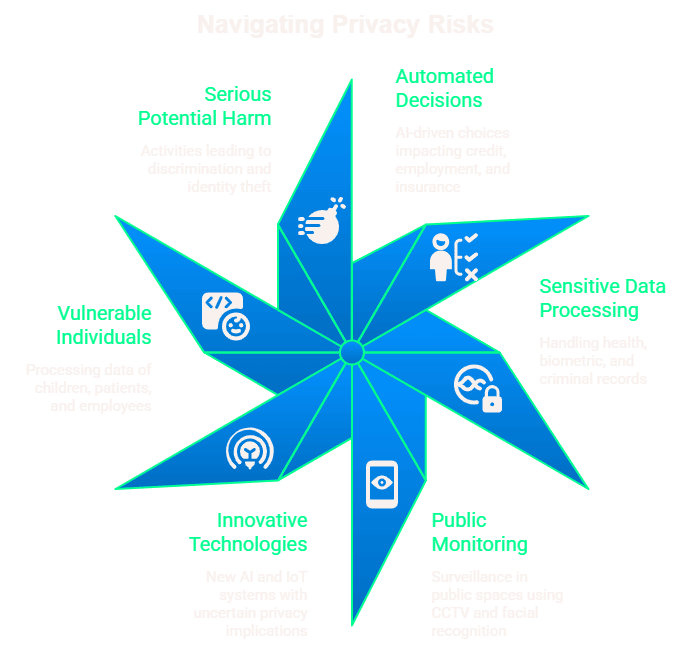
DPIA is required before processing begins when personal-data use is likely to create a high risk to individuals’ rights, privacy or safety.
Key triggers include:
- Automated decisions and profiling: Decisions on credit, employment or insurance that significantly affect individuals.
- Sensitive-data processing: Large-scale use of health, biometric, genetic or criminal-record information.
- Public monitoring: Extensive CCTV, facial recognition, location tracking or surveillance of public spaces.
- Innovative technologies: AI, IoT or biometric systems that introduce new or uncertain privacy risks.
- Vulnerable individuals: Processing involving children, patients, employees or people with limited control over their data.
- Serious potential harm: Activities that may cause discrimination, identity theft, financial loss or privacy violations.
Read also: DPDP Privacy Policy Requirements
What Happens If a DPIA Is Not Done Properly?
An incomplete or missing DPIA can leave serious risks unmanaged and weaken the organisation’s ability to demonstrate lawful, accountable processing.
Possible consequences include:
- Regulatory investigation or enforcement
- Financial penalties where a DPIA was legally required
- Delayed launches and expensive system redesign
- Weak evidence during audits or customer reviews
- Unidentified discrimination or privacy harm
- Poor handling of sensitive or excessive information
- Loss of customer, employee or public trust
- Failure to consult a regulator when high residual risk remains
What Is the DPIA Learning Path for Teams?
DPIA learning path should help employees progress from basic privacy awareness to confident screening, risk assessment, documentation and ongoing review.
Teams can develop capability through these stages:
- Awareness: Understand personal data, privacy risk and individual rights.
- Screening: Recognise when a DPIA requirement may apply.
- Data mapping: Document collection, use, sharing, storage and deletion.
- Risk assessment: Evaluate likelihood, severity and affected individuals.
- Control design: Select technical and organisational safeguards.
- Documentation: Record evidence, decisions, owners and residual risks.
- Review: Reassess DPIAs when systems, purposes or threats change.
Role-based training should include short scenarios for project managers, developers, HR, marketing, security, legal and privacy teams so that DPIA screening becomes part of normal project governance rather than a last-minute approval step.
Read also: DPDP Data Protection & Security
Conclusion
A DPIA is required when personal-data processing may create a high risk to individuals, especially through profiling, sensitive information, monitoring, large-scale operations or innovative technologies. Organisations should screen projects early, document decisions and treat every DPIA as a living risk-management process.
Explore SecuRetain’s learning platform and our all courses to build practical knowledge in cybersecurity, compliance, risk management, audit, business continuity, disaster recovery, fraud management, and employee awareness training.
You can also visit our website to explore how SecuRetain helps professionals and organizations strengthen skills, improve awareness, and support continuous learning in a structured and scalable way.
FAQ’s
Sensitive, biometric, genetic, health, criminal-offence and highly personal information commonly require closer DPIA screening.
Large-scale processing depends on the number of people, data volume, processing duration and geographical reach rather than one fixed threshold.
Record the screening questions, processing context, risk factors considered, decision, reasoning, approver and review date.
The organisation should not begin processing until it has considered whether consultation with the relevant supervisory authority is required.
Review it when purposes, technologies, data types, vendors, scale, retention, security threats or affected groups change.
Want to operationalize this into your DPDP program?
Talk with our team to map safeguards to evidence, owners, and ongoing monitoring - so your privacy posture holds up during audits.
Related reads
Keep exploring
 DPDP
DPDPLearn what a DPIA under the DPDP Act is, when it is required, key elements, risk assessment steps, best practices, and FAQs for Data Protection Impact Assessments.
 DPDP
DPDPPrivacy Impact Assessment (PIA) is a structured process that helps organizations identify, evaluate, and reduce privacy risks before collecting, processing, or sharing personal data.
 DPDP
DPDPUnderstand India's Personal Data Protection Act, including its scope, key terms, business duties, individual rights, enforcement, penalties, and practical DPDP compliance steps.