8 Essential Risk Management Frameworks and Standards Explained for Organizations

- Published:
- Last Updated:
Risk management frameworks and standards help organizations manage uncertainty through a structured process for identifying, assessing, treating, monitoring, and reporting risks. In this guide, you will learn why these frameworks matter, their key components, eight essential frameworks, implementation steps, best practices, and how training helps teams apply them effectively.
Overview
Risk management frameworks and standards help organizations manage uncertainty in a structured way. They guide teams in identifying, assessing, controlling, monitoring, and improving how risks are handled across the business.
Organizations use them for cybersecurity, compliance, operational, financial, vendor, audit, privacy, fraud, and business continuity risks. Instead of managing risks randomly, these frameworks create a common process, clear accountability, and better decision-making.
This guide explains what risk management frameworks are, why they matter, key benefits, important components, major frameworks, implementation steps, best practices, and the role of training.
Key Findings
A strong risk framework helps teams manage risk with clarity, consistency, and accountability.
Key points include:
- Risk frameworks help organizations identify, assess, treat, monitor, and report risks.
- Standards create a common approach across teams, systems, vendors, and processes.
- Frameworks support compliance, governance, cybersecurity, audit readiness, and business continuity.
- Training is essential because frameworks work only when employees know how to apply them.
- Organizations may use one framework or combine several based on industry, maturity, and compliance needs.
Recommendations
A risk framework becomes useful only when teams can apply it in real situations. It should guide how risks are reviewed, controlled, documented, and reported across the organization.
Organizations should:
- Choose frameworks that match their risk profile and business priorities.
- Define who is responsible for each risk activity.
- Create a standard method for rating risks and mapping controls.
- Provide role-based training for employees and managers.
- Update the framework after audits, incidents, regulatory changes, or process changes.
- Keep proper records, evidence, and reports for compliance readiness.
What Are Risk Management Frameworks and Standards?
Risk management frameworks and standards are structured guidelines that help organizations manage risk in a repeatable and practical way. A framework explains how risks should be identified, assessed, treated, monitored, and reported. A standard usually provides accepted requirements, principles, or best practices that organizations can follow. Risk management frameworks give organizations a structured way to manage IT, cyber, compliance, and operational risks with clear controls and ownership. Thakkar, Megha. "Comprehensive IT Risk Management Framework Guide." Scrut, March 6, 2025. Updated June 11, 2026.
These frameworks help organizations avoid inconsistent risk decisions. For example, one team may rate a risk as high, while another may rate a similar risk as low. A framework creates a common method so teams can evaluate risk more fairly and consistently.
Why Do Organizations Need Risk Management Frameworks?
Risk frameworks are important because business risks are often connected. A technology issue can affect compliance, operations, customer trust, and business continuity. A process gap, vendor delay, or control failure can create wider business impact if it is not managed early. A risk-based approach helps organizations prioritize exposed assets, control gaps, and security issues based on business impact. Thielemann, Katell, and Jay Phipps. "First Take: CISA Redefines Exposure Management as a Risk-Based Discipline." Gartner, June 10, 2026.
A framework helps organizations:
- Create a common risk language.
- Assign clear risk ownership.
- Prioritize high-impact risks.
- Support leadership decision-making.
- Monitor controls and risk trends.
- Build accountability across teams.
What Are the Benefits of an Effective Risk Management Framework?
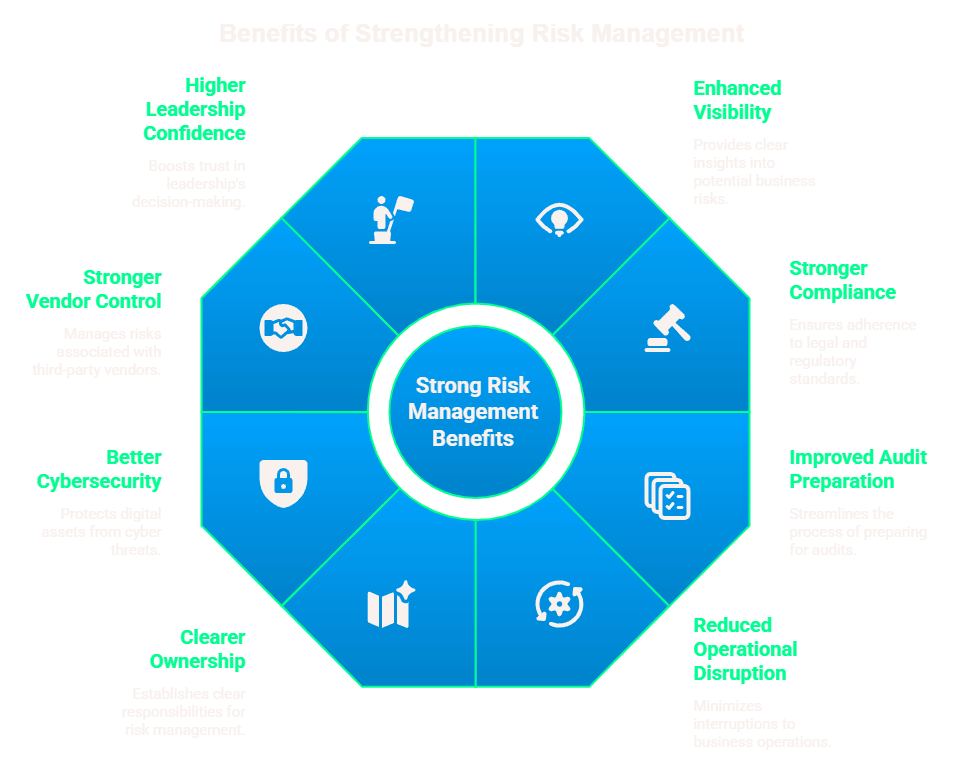
An effective risk management framework helps organizations move from reactive problem-solving to proactive risk control. It gives teams a structured way to detect issues early, apply controls, and reduce business exposure.
Key benefits include:
- Better visibility into business risks
- Stronger compliance posture
- Improved audit preparation
- Reduced operational disruption
- Clearer ownership and accountability
- Better cybersecurity and data protection
- Stronger vendor and third-party control
- Higher confidence in leadership decisions
What Are the Key Components of the Risk Management Framework?
Every effective risk framework is built on a few core elements. These elements help teams understand risks, decide priorities, apply the right controls, and keep risk activities consistent across the organization.
These elements keep risk management consistent:
| Component | Purpose |
|---|---|
| Governance | Defines roles, responsibilities, and oversight |
| Risk identification | Finds risks across business areas |
| Risk assessment | Measures likelihood, impact, and severity |
| Risk treatment | Decides whether to avoid, reduce, transfer, or accept risk |
| Controls | Uses policies, training, tools, and processes to reduce risk |
| Monitoring | Tracks risk status and control effectiveness |
| Reporting | Gives leaders visibility into key risks |
| Documentation | Maintains evidence for audits and compliance |
What Are the 8 Essential Risk Management Frameworks for Organizations?
Different frameworks support different risk areas. Some are broad enterprise frameworks, while others focus on cybersecurity, IT governance, privacy, or industry-specific requirements. Different risk management frameworks support different needs, from enterprise risk and cybersecurity to IT governance and compliance. Wickramasinghe, Shanika. "Top Risk Management Frameworks To Use." Splunk, December 2, 2024.
1. ISO 31000
ISO 31000 provides general principles and guidelines for managing risk across an organization. It is useful for enterprise-wide risk management and can be applied across industries.
2. COSO ERM Framework
COSO ERM connects risk management with strategy, governance, performance, and decision-making. It is useful for leadership teams that want risk management to support business objectives.
3. NIST Risk Management Framework
The NIST Risk Management Framework helps organizations manage security and privacy risks in information systems. It supports control selection, assessment, authorization, and continuous monitoring.
4. NIST Cybersecurity Framework
The NIST Cybersecurity Framework helps organizations manage cybersecurity risk through key functions such as identify, protect, detect, respond, and recover.
5. ISO/IEC 27001
ISO/IEC 27001 supports information security management. It helps organizations protect data through policies, risk assessment, controls, monitoring, and continual improvement.
6. COBIT
COBIT helps organizations govern and manage enterprise IT. It connects IT goals, business goals, controls, governance, and risk management.
7. OCTAVE
OCTAVE focuses on information security risk evaluation. It helps organizations identify critical assets, threats, vulnerabilities, and mitigation priorities.
8. HITRUST / HIPAA-Aligned Risk Practices
HITRUST and HIPAA-aligned practices are useful for healthcare and data-sensitive environments where privacy, security, compliance, and risk controls are important.
How to Build and Implement a Risk Management Plan?
A risk management plan turns the framework into practical action. It explains how risks will be identified, assessed, assigned, controlled, monitored, and reported.
Organizations can follow these steps:
- Define the scope: Decide which departments, systems, vendors, or risks are included.
- Identify risks: Collect risks from audits, incidents, business processes, vendors, and technology.
- Assess risks: Review likelihood, impact, urgency, and business importance.
- Assign ownership: Give each major risk a responsible owner.
- Select controls: Apply policies, training, approvals, monitoring, or technical safeguards.
- Track progress: Review open risks, overdue actions, gaps, and improvement plans.
- Document evidence: Maintain records for audits, compliance, and leadership reporting.
What Are the Best Practices for Risk Management Framework Implementation?
Risk frameworks should be more than written processes. They should help teams manage real risks, follow clear controls, receive proper training, and review results regularly to confirm the framework is working. NIST CSF helps assess cybersecurity posture, while FAIR helps quantify cyber risk in financial terms for better decision-making. Whelan, Cody. "How NIST CSF Risk Assessments and the FAIR Risk Model Are Complementary." Safe Security, June 10, 2022.
Best practices include:
- Align the framework with business goals.
- Keep risk scoring simple and consistent.
- Assign clear risk owners.
- Train employees on responsibilities.
- Review risks regularly.
- Maintain evidence and documentation.
- Connect reporting with leadership decisions.
- Improve the framework after incidents, audits, or process changes.
Why Employee Training Is Important for Risk Framework Implementation?
Employee training is important because frameworks are only effective when people understand how to apply them.
Training helps employees understand:
- What risk means in their role
- How to report risks or incidents
- Why controls must be followed
- How policies support compliance
- How cyber, vendor, operational, and data risks affect the business
How SecuRetain Helps Organizations Build Framework-Aware and Risk-Ready Teams?
SecuRetain helps organizations build framework-aware and risk-ready teams through eLearning, certification courses, employee awareness programs, and corporate training.
SecuRetain helps organizations:
- Train employees on risk frameworks and controls.
- Build awareness around cyber, vendor, cloud, fraud, audit, and compliance risks.
- Customize courses based on internal policies and procedures.
- Support learning around frameworks such as ISO, COSO, NIST, HIPAA, and HITRUST.
- Track learner progress and course completion.
Conclusion
Risk management frameworks and standards help organizations manage uncertainty with structure, consistency, and accountability. They support governance, compliance, cybersecurity, audit readiness, operational resilience, and better decision-making.
The best framework depends on the organization's goals, industry, risk maturity, and compliance needs.
Explore SecuRetain's learning platform and courses to build practical knowledge in cybersecurity, compliance, risk management, audit, business continuity, disaster recovery, fraud management, and employee awareness training.
You can also visit SecuRetain to explore how professionals and organizations can strengthen skills, improve awareness, and support continuous learning in a structured and scalable way.
FAQs
A risk management framework is a structured method for identifying, assessing, managing, monitoring, and reporting risks across an organization.
Risk management frameworks are important because they create consistency, accountability, and better control over business, cyber, compliance, and operational risks.
A framework gives a structured approach, while a standard provides accepted requirements, principles, or best practices to follow.
You implement a risk management framework by defining scope, identifying risks, assessing impact, assigning owners, applying controls, monitoring progress, and documenting evidence.
Yes, organizations can use multiple frameworks to manage enterprise risk, cybersecurity, privacy, audit, compliance, and industry-specific requirements.
Turn risk frameworks into everyday practice
Use SecuRetain learning paths to help teams apply risk frameworks, controls, compliance evidence, and audit-ready practices with confidence.
Related reads
Keep exploring
 DPDP
DPDPMaster privacy risk management under India's DPDP Act with this practical 7-step approach. Implement assessments, controls, monitoring, and remediation for Data Fiduciaries to...
 DPDP
DPDPComplete guide to maintaining records of personal data processing under India's DPDP Act. Learn data inventory, consent logs, DPIA documentation, and audit trails required for...
 Risk Management
Risk management is the structured process of identifying, assessing, controlling, and monitoring risks that may affect an organization's goals, operatio...