What Is a Vulnerability Report? A Guide to How Ethical Hackers Create It

- Published:
- Last Updated:
Before any security weakness can be fixed, it must be clearly documented, prioritized, and explained. A vulnerability report helps organizations do exactly that by turning ethical hacking or vulnerability assessment findings into practical security guidance.
Overview
A vulnerability report is a structured security document that explains weaknesses found during ethical hacking or vulnerability assessment. It helps organizations understand what was tested, what risks were discovered, how serious each issue is, and what actions are needed to fix them.
This article will help readers understand what a vulnerability report is, why businesses need it, what it should include, how ethical hackers create it, and how organizations can use it.
Key Findings
- A vulnerability report converts technical security findings into clear business and remediation actions.
- It usually includes scope, affected assets, vulnerability details, severity, evidence, business impact, remediation steps, owner, and retest status.
- It helps security, IT, compliance, audit, and leadership teams prioritize risks based on severity and business impact.
- It supports audit readiness by documenting testing evidence, corrective actions, accepted risks, and closure status.
- A strong report reduces confusion by explaining both the technical issue and the possible effect on data, systems, users, operations, or compliance.
- Ethical hackers must validate findings carefully so teams focus on real risks instead of false positives.
Recommendations
Organizations should use vulnerability reports as practical risk-reduction documents.
- Fix critical and high-risk vulnerabilities first.
- Add clear evidence such as screenshots, logs, affected URLs, or configuration details.
- Explain business impact in simple language.
- Assign ownership for every finding.
- Track each issue as open, in progress, fixed, accepted, or retested.
- Use repeated findings to improve patching, access control, monitoring, employee awareness, and cybersecurity training.
What is a vulnerability report?
A vulnerability report is a formal security document that records identified weaknesses in systems, applications, networks, or processes. It explains what was found, how serious the issue is, what business risk it creates, and what actions are required to fix it.
It turns technical testing results into clear business information. Ethical hackers may find missing patches, weak passwords, insecure configurations, exposed services, access control gaps, or application flaws. The report helps security teams, IT teams, compliance officers, and business leaders understand what needs attention first.
Responsible ethical hacking requires authorized testing, clear documentation, and practical reporting that helps organizations improve security. Forbes Technology Council editors highlight this in "Ethics and Hacking: What You Need to Know" (published March 6, 2017).
Why Do Businesses Need a Vulnerability Report?
Businesses need a vulnerability report to understand which security weaknesses matter most and what should be fixed first.
These are the main business reasons:
- Helps teams focus on high-risk issues first.
- Keeps testing and remediation evidence audit-ready.
- Improves communication across security, IT, compliance, and leadership.
- Reduces chances of data exposure, unauthorized access, service disruption, and regulatory issues.
- Documents what was tested, found, and fixed.
- Builds employee awareness of risks from weak passwords, misconfigurations, and poor access controls.
Without proper reporting, security issues may remain hidden or unresolved. A report helps organizations answer practical questions such as:
- Which vulnerability is most critical?
- Which asset is affected?
- What could happen if it is exploited?
- Who should fix it?
- What evidence proves the issue exists?
- Has remediation been completed
Read also: Cybersecurity for Small Businesses: What Every Owner Should Know
What Should a Vulnerability Report Include?
A strong security vulnerability report should be clear, evidence-based, and easy to act on. It should not only list technical issues but also explain their business impact.
The table below shows the key components clearly:
| Component | What It Means | Why It Matters |
|---|---|---|
| Executive Summary | Short overview of major findings | Helps leadership understand risk quickly |
| Scope | Systems, apps, or networks tested | Defines what was reviewed |
| Finding Title | Clear name of the vulnerability | Makes tracking easier |
| Affected Asset | System, URL, endpoint, server, or process | Shows where the issue exists |
| Severity Rating | Critical, high, medium, or low | Helps prioritize remediation |
| Evidence | Screenshots, logs, URLs, or test output | Supports validation and audit records |
| Business Impact | Possible effect on data, users, compliance, or operations | Connects technical risk with business risk |
| Remediation Steps | Recommended corrective actions | Guides teams toward resolution |
| Retest Status | Open, fixed, accepted, or retested | Tracks closure and accountability |
What are Key Components of a Vulnerability Report?
That report includes the main details needed to understand, verify, prioritize, and fix security weaknesses.
Key components include:
- Scope: What was tested.
- Finding: What weakness was found.
- Affected Asset: Where the issue exists.
- Severity: How serious the risk is.
- Evidence: Proof of the issue.
- Impact: Possible business or security effect.
- Remediation: How to fix it.
- Status: Open, fixed, or retested.
A vulnerability report is valuable when it clearly explains findings, severity, evidence, impact, and remediation steps. C. Wallis explains this in "Vulnerability Assessment Reporting: Beginner's Guide" (published January 30, 2024).
How Ethical Hackers Write a Vulnerability Report?
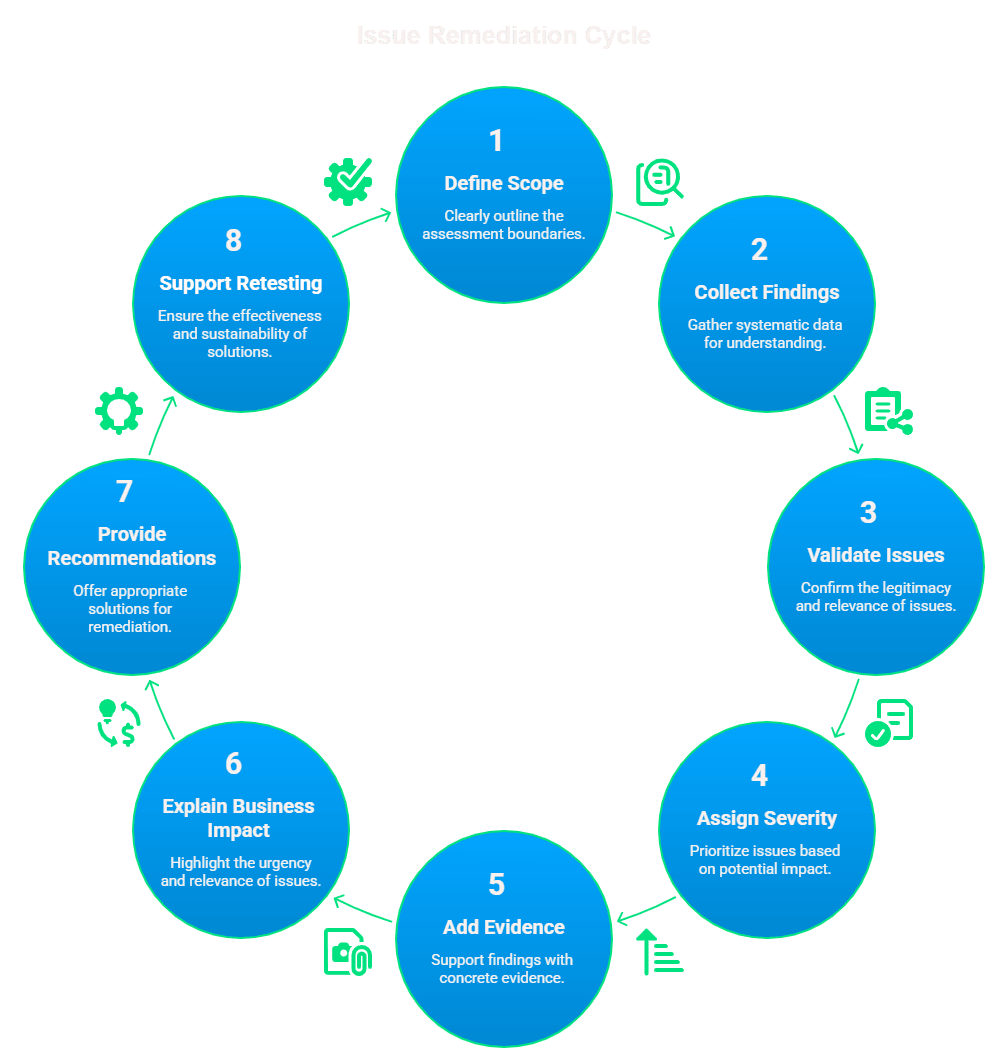
Ethical hackers write reports by validating findings, rating risk, adding evidence, explaining business impact, and recommending practical fixes.
This process usually includes the following steps:
- 1.Define the scope
Ethical hackers first confirm what systems, applications, networks, or workflows are approved for testing. - 2.Collect findings
They gather results from manual testing, automated scanning, configuration review, and controlled exploitation. - 3.Validate each issue
They check whether the vulnerability is real to avoid false positives. - 4.Assign severity
Each finding is rated based on exploitability, impact, likelihood, and affected asset value. - 5.Add evidence
Evidence may include screenshots, URLs, request-response data, logs, or tool output. - 6.Explain business impact
The report explains what could happen if the weakness is exploited. - 7.Recommend remediation
Fixes may include patching, access control changes, configuration updates, password improvements, or monitoring enhancements. - 8.Support retesting
After fixes are completed, ethical hackers may retest the issue and update its status.
Read more: What Is a Zero-Day in Ethical Hacking?
Six Critical Elements of a Vulnerability Assessment Report
The six critical elements of a vulnerability assessment report are finding title, affected asset, severity, evidence, impact, and remediation guidance.
These elements make the report clear, useful, and action-oriented:
- Issue Summary: A short description of the security weakness.
- Location: The system, application, endpoint, or process affected.
- Risk Level: The urgency of the issue, such as critical, high, medium, or low.
- Proof: Evidence that confirms the weakness is real.
- Possible Damage: The risk to data, users, systems, operations, or compliance.
- Fix Recommendation: Practical steps to reduce or remove the risk.
Vulnerability report vs penetration test report: What is the difference?
A vulnerability report focuses on identifying and prioritizing weaknesses, while a penetration test report explains how ethical hackers tested and validated real attack paths.
The comparison below explains the difference:
Vulnerability Report
- Focuses on identifying and listing security weaknesses.
- Covers a broader assessment of systems, applications, networks, or processes.
- Provides a list of validated vulnerabilities with severity and remediation steps.
- Best used for regular security checks & risk tracking.
- Helps businesses prioritize which vulnerabilities should be fixed first.
Penetration Test Report
- Focuses on simulating real-world attacker behavior.
- Goes deeper by testing how vulnerabilities can actually be exploited.
- Shows attack paths, exploitation evidence, and possible impact.
- Best used to understand how attackers could compromise systems.
- Helps businesses improve defenses and strengthen overall security strategy.
Ethical hacking helps organizations find and fix weaknesses before attackers misuse them. E. Woollacott discusses this in "What Is Ethical Hacking? Using Hacking Techniques for Good" (published March 25, 2026).
Read more: Password Management Best Practices Explained
Conclusion
Clear reporting is what turns ethical hacking findings into real security action. It helps organizations see what was tested, what weaknesses were found, how serious each issue is, and what steps are needed to fix them.
Explore SecuRetain's learning platform and our all courses to build practical knowledge in cybersecurity, compliance, risk management, audit, business continuity, disaster recovery, fraud management, and employee awareness training.
You can also visit our website to explore how SecuRetain helps professionals and organizations strengthen skills, improve awareness, and support continuous learning in a structured and scalable way.
FAQ's
It is a structured document that explains identified security weaknesses, their severity, proof, business impact, and recommended fixes.
It helps organizations identify weak areas early, prioritize risks, protect sensitive data, and support better compliance and audit readiness.
It gives teams a clear record of issues, affected assets, evidence, ownership, remediation steps, and retest status.
It should include scope, findings, affected systems, severity, evidence, impact, fix recommendations, responsible owners, and current status.
Ethical hackers, penetration testers, security analysts, or assessment teams usually prepare it after authorized testing and validation.
Build practical cybersecurity reporting skills
Explore courses that help learners understand vulnerability assessment, ethical hacking, reporting, remediation, and business-focused cybersecurity risk reduction.
Related reads
Keep exploring
 Cybersecurity
A step-by-step guide to conducting vulnerability assessments safely, from scope and asset discovery to scanning, prioritization, remediation, and reassessment.
 Ethical Hacking
A zero-day is an unknown or unpatched vulnerability; learn its lifecycle, discovery methods, and how ethical hackers handle it responsibly.
 Ethical Hacking
Basic penetration testing is an authorized security assessment that helps identify, validate, and report security weaknesses before attackers can misuse them.