What Is Meant by Risk Management? A Complete Guide

- Published:
- Last Updated:
Risk management is the structured process of identifying, assessing, controlling, and monitoring risks that may affect an organization's goals, operations, compliance, finances, reputation, and security. It helps businesses understand what could go wrong, measure the possible impact, prioritize the most serious risks, and take practical steps to reduce uncertainty before it becomes a major problem.
Overview
Risk management is the structured process of identifying, assessing, controlling, and monitoring risks that may affect an organization's goals. It helps businesses prepare for uncertainty, reduce losses, improve decision-making, and build a safer operating environment. Tucci, Linda, and Craig Stedman. "What Is Risk Management? Importance, Benefits and Guide." TechTarget, July 1, 2025.
Risk can come from people, processes, technology, vendors, regulations, cyber threats, financial issues, or unexpected business changes. In this guide, you will learn what risk management means, why it is important, the main types of risk, key process steps, risk assessment purpose, benefits, approaches, and how organizations can build risk-aware teams through training and continuous monitoring.
Key Findings
Organizations use risk management to reduce uncertainty and make informed decisions. Bhattacharya, Tapas. "Redefining Risk Toward Its Management." ISACA Journal 1 (2022). Published February 10, 2022.
The most important points are:
- Risk management helps identify problems before they become serious.
- Risk assessment measures likelihood and impact.
- Common risks include cyber, compliance, operational, financial, and third-party risks.
- Employee training helps reduce human-related risks.
- AI supports monitoring but also needs proper controls.
Recommendations
Organizations should treat risk management as an ongoing business practice, not a one-time activity.
Vicente, Vice. "The Essentials of Integrated Risk Management (IRM)." Optro, May 11, 2023.
To strengthen risk management, organizations should:
- Create a clear risk management process.
- Assign ownership for key risks.
- Train employees to recognize and report risks.
- Review risks regularly as business conditions change.
- Document controls, actions, and evidence for audit readiness.
- Use technology and automation where it improves visibility and monitoring.
What Is Risk Management?
Risk management means finding possible problems before they cause damage and creating a plan to reduce their impact. It helps organizations protect people, data, operations, money, reputation, and compliance readiness.
Risk is present in every business activity. A system failure, cyberattack, vendor issue, legal change, employee mistake, or financial loss can affect business performance.
In simple terms, risk management helps organizations answer three questions:
- What can go wrong?
- How serious could it be?
- What should we do to prevent or reduce it?
A strong risk management program does not remove every risk. Instead, it helps the organization understand which risks matter most and how to respond in a practical way
5 Reasons Why Risk Management Is Important to Organizations
Risk management is important because every organization faces uncertainty. Without a structured process, small issues can turn into operational disruption, financial loss, compliance failure, or reputational damage.
Here are the main reasons risk management matters:
- 1.Identifies Risks Early: It helps organizations detect possible threats, gaps, or weaknesses before they turn into major issues.
- 2.Reduces Losses and Disruption: Risk management helps reduce downtime, delays, errors, financial loss, and operational disruption.
- 3.Improves Decision-Making: It gives leaders a clearer view of possible risks, their impact, and the actions needed to manage them.
- 4.Supports Compliance and Accountability: It helps organizations follow policies, legal requirements, standards, and audit expectations while assigning clear ownership.
- 5.Builds Trust and Stability: A strong risk management approach shows that the organization is prepared, responsible, and reliable.
What Are the Main Types of Risk?
The main types of risk include strategic, operational, financial, compliance, cybersecurity, reputational, and third-party risks. Each risk type affects the organization differently and requires a suitable response plan.
Organizations usually face more than one type of risk at the same time.
Common risk categories include:
- Strategic risk: Wrong business decisions, market changes, failed expansion, or poor planning.
- Operational risk: Process failure, human error, system downtime, or weak internal controls.
- Financial risk: Revenue loss, budget issues, fraud, or unexpected costs.
- Compliance risk: Failure to meet laws, regulations, policies, or audit requirements.
- Cybersecurity risk: Data breaches, malware, phishing, credential theft, or unauthorized access.
- Third-party risk: Problems caused by vendors, suppliers, contractors, or service providers.
- Reputational risk: Loss of trust due to poor service, incidents, or public failure.
What Are the Main Steps in the Risk Management Process?
A clear process helps organizations move from risk awareness to action. The process should be simple enough for teams to follow and strong enough to support governance and audit readiness.
The main steps are:
| Step | What It Means |
|---|---|
| Identify risks | Find possible risks across people, process, technology, vendors, and data |
| Assess risks | Measure likelihood, impact, urgency, and business relevance |
| Prioritize risks | Focus first on high-impact and high-likelihood risks |
| Select response | Choose whether to avoid, reduce, transfer, or accept the risk |
| Apply controls | Use policies, training, approvals, monitoring, or technical safeguards |
| Monitor risks | Review risks regularly and update status |
| Document evidence | Maintain records for audit, compliance, and leadership review |
What Is the Purpose of a Risk Assessment?
A risk assessment helps organizations understand how serious a risk is and what action is needed. It is one of the mThe purpose of a risk assessment is to:
- Find weak areas in processes, systems, vendors, people, or controls.
- Understand where the business is most exposed to loss, disruption, or compliance issues.
- Decide which risks need immediate attention and which can be monitored.
- Check whether existing controls are effective or need improvement.
- Create a clear action plan with ownership, timelines, and next steps.
- Support better planning, audit readiness, and responsible decision-making
For example, before adopting a new software tool, an organization may assess data access, vendor reliability, privacy impact, cybersecurity controls, user permissions, and compliance requirements.
What Are the Benefits of Risk Management?
Risk management helps organizations move from reactive decisions to proactive planning. Instead of waiting for an incident, teams can prepare controls, assign owners, and reduce exposure early.
The key benefits include:
- Better business continuity
- Reduced financial and operational loss
- Stronger audit readiness
- Improved compliance posture
- Better cybersecurity awareness
- Clear accountability
- Stronger vendor and third-party control
- Higher confidence in business decisions
What Are the Main Risk Management Approaches?
Risk treatment is not the same for every situation. Organizations choose the right approach based on how serious the risk is, how likely it is to happen, and how much it can affect business operations.
The main approaches are:
- Avoid: Stop the risky activity completely, such as not working with an unsafe vendor.
- Reduce: Lower the chance or impact of the risk by adding controls like MFA, training, monitoring, or approvals.
- Transfer: Shift part of the risk to another party through insurance, contracts, or service agreements.
- Accept: Continue with a known low-level risk after proper review, approval, and documentation.
Who Should Learn Risk Management?
Risk management is useful for almost every business role because risk is not limited to one department.
Different teams need different levels of risk knowledge:
- Employees: Spot daily risks and report issues early.
- Managers: Monitor team risks and ensure controls are followed.
- IT teams: Manage system, access, data, and technology risks.
- HR teams: Handle training, policies, and people-related risks.
- Compliance teams: Maintain policies, evidence, and regulatory records.
- Finance teams: Manage financial, fraud, budget, and reporting risks.
- Auditors: Review controls and identify gaps.
- Cybersecurity professionals: Protect systems, networks, and data.
- Business leaders: Use risk insights for better decisions.
How Is Artificial Intelligence Used in Risk Management?
Artificial intelligence can support risk management by helping teams analyze data, detect patterns, monitor unusual activities, and improve decision-making speed. It can be useful when organizations need to review large amounts of information.
AI can help with:
- Risk scoring
- Fraud detection
- Security alert analysis
- Vendor risk monitoring
- Policy review support
- Incident trend analysis
- Compliance evidence tracking
- Predictive risk insights
How SecuRetain Helps Organizations Build Risk-Aware Teams
SecuRetain helps organizations build risk-aware teams through risk management eLearning, certification courses, and corporate training. Its courses help employees understand how to identify, assess, control, treat, and monitor risks in a structured way.
SecuRetain helps organizations:
- Train employees on risk identification, assessment, controls, and monitoring.
- Build awareness around vendor, third-party, cloud, fraud, audit, and compliance risks.
- Support learning around frameworks such as COSO, ISO 31000, NIST, HIPAA, and HITRUST.
- Customize courses based on internal policies and procedures.
- Track learner progress and course completion.
With the right training, employees can recognize risks earlier, follow safer practices, and support a stronger risk management culture.
Conclusion
Risk management helps organizations identify uncertainty, reduce exposure, and make better decisions. It includes risk identification, assessment, prioritization, response, controls, monitoring, and documentation.
A strong risk management culture depends on trained people, clear processes, accountable owners, and continuous review.
Explore SecuRetain's learning platform and courses to build practical knowledge in cybersecurity, compliance, risk management, audit, business continuity, disaster recovery, fraud management, and employee awareness training.
You can also visit SecuRetain to explore how professionals and organizations can strengthen skills, improve awareness, and support continuous learning in a structured and scalable way.
FAQs
Risk management is the process of finding possible problems, understanding their impact, and taking action to reduce or control them before they harm the organization.
The main steps are risk identification, risk assessment, prioritization, risk response, control implementation, monitoring, and documentation.
Risk management is important because it helps organizations prevent losses, meet compliance needs, improve decisions, and stay prepared for uncertainty.
Risk assessment is one part of risk management. It focuses on identifying and evaluating risks, while risk management includes response, monitoring, ownership, and improvement.
Yes, AI can improve risk management by analyzing data, detecting patterns, automating monitoring, and supporting faster risk insights. Human review is still required.
Build practical risk management capability
Explore SecuRetain courses and functional programs that help teams understand risk, compliance, audit readiness, cybersecurity, and business resilience.
Related reads
Keep exploring
 DPDP
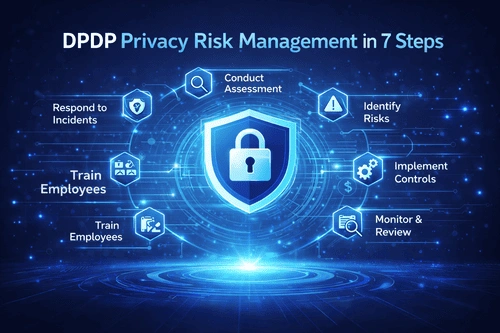
DPDPMaster privacy risk management under India's DPDP Act with this practical 7-step approach. Implement assessments, controls, monitoring, and remediation for Data Fiduciaries to...
 Cybersecurity
A vulnerability report is a structured security document that explains weaknesses found during ethical hacking or vulnerability assessment.
 Risk Management
Risk management frameworks and standards help organizations manage uncertainty through a structured process for identifying, assessing, treating, monito...