Cybersecurity for Small Businesses: 10 Essential Steps to Reduce Risk

- Published:
- Last Updated:
Cybersecurity for small businesses means protecting critical accounts, devices, employees, customer data, and daily operations from digital threats. The most effective approach starts with multi-factor authentication, strong access controls, software updates, secure backups, employee awareness, vendor oversight, and an incident response plan that reduces disruption, financial loss, and compliance risk.
Overview
Cybersecurity for small businesses means reducing the likelihood and impact of phishing, ransomware, stolen passwords, data exposure, payment fraud, and operational disruption. It combines technology, employee behaviour, clear ownership, and recovery planning. As discussed in Aung, Ryan. “Cybersecurity for SMBs: Essential Steps to Safeguard Your Business.” Forbes, January 7, 2025, small businesses need practical and layered security measures to protect their essential systems and operations.
Small businesses should protect the systems supporting sales, payroll, customer service, communication, and legal obligations. Security must evolve as employees, vendors, devices, and risks change.
Key Findings
The best starting point is to protect identities, critical data, employees, and recovery capability before investing in complex tools. This business-focused approach is consistent with Gabrys, Ed, and Mike Ramsey. “Cybersecurity for CIOs: Build Resilience and Mitigate Risk in the AI Age.” Gartner, May 15, 2026.
Priorities include:
- Email, banking, administrator, payroll, and cloud accounts
- Customer, employee, financial, and confidential information
- Secure, tested backups
- Fast installation of security updates
- Employee awareness of phishing and payment fraud
- Clear incident ownership and reporting
Weak cybersecurity can cause downtime, lost revenue, recovery costs, compliance concerns, and reputational harm. Cybersecurity for small businesses therefore supports resilience and trust, not only technical protection.
Read also: What Is Enumeration in Ethical Hacking?
What Does Cybersecurity for Small Businesses Mean?
Cybersecurity for small businesses is the coordinated protection of business systems, online accounts, devices, employees, and sensitive information. It helps prevent attacks, limit operational disruption, protect customer trust, and support faster recovery when an incident occurs.
The programme should cover the systems and information that support:
- Sales and customer service
- Payroll and business banking
- Email and cloud applications
- Customer and employee information
- Websites and business operations
- Legal and compliance responsibilities
Why Are Small Businesses Targeted by Cybercriminals?
Small businesses may be targeted because attackers expect weaker controls, fewer security staff, and limited monitoring. One stolen password or fraudulent invoice can expose email, payment systems, cloud files, or customer records.
Common entry points include phishing, reused passwords, unpatched software, unmanaged devices, excessive administrator access, compromised vendors, unsafe Wi-Fi, and unapproved AI tools.
What Are the Most Important Cybersecurity Findings for Small Businesses?
Small businesses should prioritise identity protection, employee awareness, data recovery, and incident preparedness before purchasing complex tools. These areas address several common attack paths and provide measurable business benefits.
The most important findings are:
- Email, administrator, banking, and cloud accounts should be protected first.
- Multi-factor authentication reduces dependence on passwords alone.
- Employees need practical training, not only annual policy presentations.
- Backups must be separated from operational systems and tested regularly.
- Software updates should be installed before known weaknesses are exploited.
- Vendor access should be limited and reviewed.
Read also: What Are Social Engineering Attacks?
What Should a Small Business Protect First?
A small business should first protect the accounts, information, and systems whose loss would stop operations or expose sensitive data. Security priorities should be based on business impact rather than tool popularity.
The following table provides a practical starting point:
| Priority area | First action | Main risk reduced |
|---|---|---|
| Business identity | Enable multi-factor authentication | Account takeover |
| Sensitive data | Restrict access by role | Data exposure |
| Employee devices | Apply updates and endpoint protection | Malware and ransomware |
| Critical operations | Create and test backups | Extended downtime |
| Vendors | Review third-party access | Supply-chain compromise |
| Employees | Provide practical awareness training | Phishing and human error |
10 Essential Steps Can Small Businesses Take to Reduce Cyber Risk?
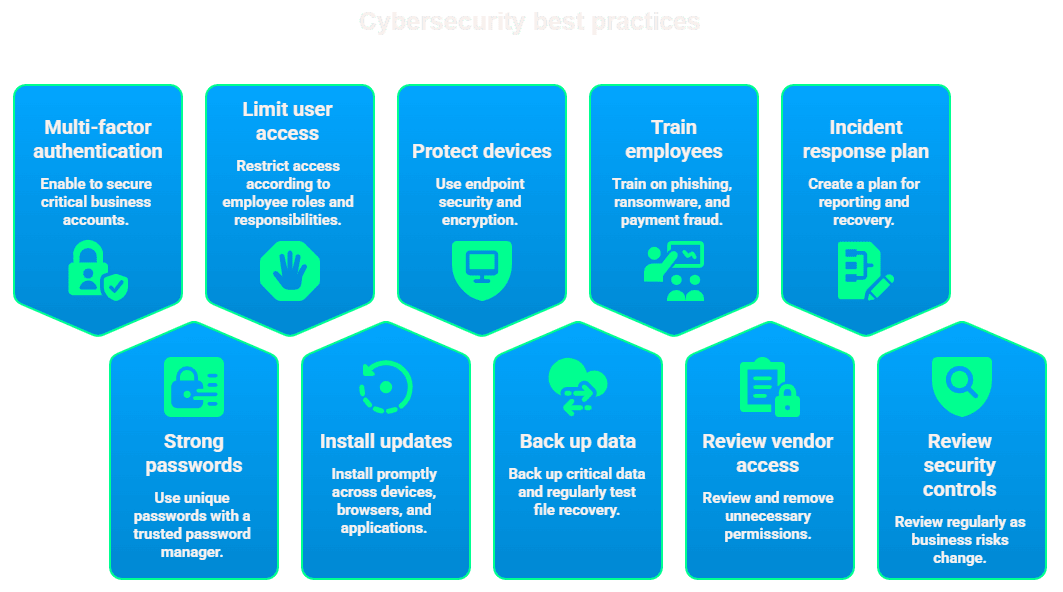
Small businesses can reduce cyber risk by protecting critical accounts, limiting access, updating systems, testing backups, training employees, and preparing for security incidents.
The following actions provide a strong cybersecurity foundation:
- 1.Enable multi-factor authentication to secure critical business accounts.
- 2.Use strong, unique passwords with a trusted password manager.
- 3.Limit user access according to employee roles and responsibilities.
- 4.Install updates promptly across devices, browsers, and applications.
- 5.Protect business devices with endpoint security and encryption.
- 6.Back up critical data and regularly test file recovery.
- 7.Train employees on phishing, ransomware, and payment fraud.
- 8.Review vendor access and remove unnecessary permissions.
- 9.Create an incident response plan for reporting and recovery.
- 10.Review security controls regularly as business risks change.
What Common Cybersecurity Mistakes Should Be Avoided?
Businesses should avoid relying on one security product or assuming that a small workforce creates a low-risk environment.
Common mistakes include:
- Treating antivirus as complete protection
- Sharing administrator accounts
- Delaying important updates
- Giving employees more access than required
- Keeping backups permanently connected
- Using personal email for business files
- Allowing unapproved cloud or AI tools
- Providing training only once a year
- Failing to test the incident-response process
How Can a Small Business Improve Cybersecurity in 30 Days?
A small business can establish a practical security baseline within 30 days by dividing the work into account protection, device security, employee preparation, and incident readiness. A structured sequence of actions reflects the practical guidance provided in Brooks, Chuck. “A Cybersecurity Cheat Sheet: 10 Steps for Businesses to Follow.” Forbes, August 30, 2025, which presents clear steps businesses can follow to strengthen their cybersecurity posture.
Follow this four-week plan:
Days 1–7: Protect Business Accounts
Enable multi-factor authentication, introduce a password manager, remove unused accounts, and review administrator permissions.
Days 8–14: Protect Devices and Information
Install updates, activate endpoint protection, identify sensitive data, configure backups, and complete a test restoration.
Days 15–21: Prepare Employees
Train employees on phishing, invoice fraud, password safety, customer-data handling, remote work, suspicious links, and safe AI use.
Days 22–30: Prepare for an Incident
Assign an incident lead, document emergency contacts, identify critical systems, test internal reporting, and run a short response exercise.
Read more: How Ethical Hacking Helps Identify Credential Theft Risks
How Should Employees Use AI Tools Safely?
Employees should use only approved AI tools and must avoid entering customer information, passwords, contracts, employee records, source code, or confidential business plans into unapproved platforms.
A basic AI-use policy should require employees to:
- Check whether submitted information is stored
- Review access permissions for AI integrations
- Avoid uploading confidential documents
- Verify AI-generated links and instructions
- Confirm financial requests through a separate channel
- Report accidental disclosure immediately
What Should a Small Business Do After a Cyberattack?
A small business should contain the incident, protect evidence, secure critical accounts, assess the impact, and recover only from trusted systems. Employees should know exactly whom to contact instead of attempting unplanned fixes.
The immediate response should include:
- Disconnect affected devices from the network.
- Contact the assigned incident lead or IT provider.
- Preserve messages, logs, files, and other evidence.
- Secure administrator, banking, and email accounts.
- Record what happened and when it was discovered.
- Identify affected systems and information.
- Restore operations from verified backups.
- Review legal, contractual, and notification requirements.
- Communicate through a secure, unaffected channel.
- Correct the control or process that failed.
Conclusion
Cybersecurity for small businesses starts with simple, consistent actions: secure accounts, update systems, protect backups, limit access, train employees, and prepare for incidents. These steps reduce downtime, financial loss, data exposure, and reputational damage. The earlier a business acts, the easier and more affordable it is to strengthen security.
Explore SecuRetain’s learning platform and our all courses to build practical knowledge in cybersecurity, compliance, risk management, audit, business continuity, disaster recovery, fraud management, and employee awareness training.
You can also visit our website to explore how SecuRetain helps professionals and organizations strengthen skills, improve awareness, and support continuous learning in a structured and scalable way.
FAQ's
Phishing is one of the most common risks because it targets employees through deceptive emails, links, and payment requests.
A small business needs protection for accounts, devices, data, employees, backups, vendors, and incident response.
Yes. Small businesses are often targeted because they may have valuable data but fewer security controls and limited monitoring.
Use MFA, strong passwords, regular updates, secure backups, limited access, employee training, and incident planning.
Cybersecurity should be reviewed regularly and whenever employees, devices, vendors, systems, or business risks change.
Strengthen practical cybersecurity skills
Explore SecuRetain courses for cybersecurity, compliance, risk management, audit, and employee awareness training.
Related reads
Keep exploring
 Cybersecurity
Social Engineering Attacks manipulate people into sharing sensitive information, clicking harmful links, or taking unsafe actions through trust, urgency, fear, or curiosity.
 Cybersecurity
Proper password management in cybersecurity helps organizations prevent data breaches, protect sensitive systems, and maintain compliance.
 DPDP
DPDPUnderstand India's Personal Data Protection Act, including its scope, key terms, business duties, individual rights, enforcement, penalties, and practical DPDP compliance steps.