Ethical Hacking and Penetration Testing Guide: Meaning, Difference, Process, and Learning Path

- Published:
- Last Updated:
An ethical hacker uses authorized cybersecurity methods to identify weaknesses before attackers exploit them. Penetration testing is a focused security assessment that tests specific systems, applications, or networks. Together, ethical hacking and penetration testing help organizations reduce risk, improve security controls, support audit readiness, and build stronger cybersecurity awareness.
Overview
Organizations face growing cyber risks from weak passwords, phishing, insecure applications, cloud misconfigurations, exposed systems, poor access controls, and untrained users. Ethical hacking and penetration testing help businesses identify these risks safely before they become real security incidents.
This guide explains what ethical hacking and penetration testing mean, how the process works, how both are different, what methods and tools are commonly used, how learners can enter this field, and how organizations can use ethical hacking concepts in corporate cybersecurity training.
Key Findings
- Ethical hacking and penetration testing help find security weaknesses before attackers exploit them.
- They are done with permission, legal approval, defined scope, and safe testing methods.
- Common activities include vulnerability assessment, penetration testing, password testing, web app testing, network testing, cloud review, and social engineering awareness.
- Penetration testing gives practical evidence of exploitable risks in systems, applications, networks, or cloud environments.
- Organizations can use these concepts to train employees, IT teams, SOC teams, compliance teams, and audit teams.
Marks, Gene. "Why Pentesting Is Important for Small Businesses." Forbes Advisor, edited by Sophia Acevedo, March 14, 2026.
Recommendations
To use ethical hacking and penetration testing effectively, organizations should:
- Define the testing scope clearly before work begins.
- Get written authorization for all testing activities.
- Use safe testing methods that do not disrupt business operations.
- Map findings to business risks, security controls, and compliance requirements.
- Prioritize high-risk vulnerabilities first.
- Document findings with evidence, impact, and remediation guidance.
- Retest fixed vulnerabilities to confirm closure.
- Use testing results to improve employee training, security awareness, and cyber readiness.
Overview of Ethical Hacking
Ethical hacking is the authorized practice of testing systems, applications, networks, and users to find security weaknesses. It is performed with permission and within a defined scope.
The purpose is not to harm systems. The purpose is to identify risks, report them clearly, and help organizations improve security before real attackers misuse those gaps.
What Does the Ethical Hacking and Pentesting Process Include?
The ethical hacking and penetration testing process includes planning, information gathering, vulnerability identification, controlled testing, reporting, remediation, and retesting. OnSecurity. "Ethical Hacking vs Penetration Testing: What Is the Difference?" OnSecurity. Accessed June 26, 2026.
The process usually includes:
| Phase | What It Means | Business Value |
|---|---|---|
| Define the Scope | Confirm systems, apps, users, limits, and timelines | Keeps testing safe, legal, and controlled |
| Study the Environment | Review approved technical and business information | Shows what attackers may discover first |
| Identify Weaknesses | Check vulnerabilities, misconfigurations, and access gaps | Reveals where risk may exist |
| Test Safely | Validate selected weaknesses in a controlled way | Confirms real business impact |
| Document Findings | Record evidence, risk level, and affected systems | Helps teams act on clear information |
| Fix the Issues | Remediate weak controls, flaws, or gaps | Reduces exposure |
| Verify the Fixes | Retest corrected items | Confirms that improvements are working |
Read more: What Is a Zero-Day in Ethical Hacking?
Ethical Hacking vs Penetration Testing: What Is the Difference?
Ethical Hacking
- Look at the complete security environment.
- Identifies weak areas before attackers misuse them.
- Covers systems, users, processes, policies, and controls.
- Includes testing, awareness, advisory support, and reporting.
- Builds a stronger security culture over time.
Penetration Testing
- Focuses on one defined target or environment.
- Tests how easily a weakness can be exploited.
- Uses controlled attack-like methods with permission.
- Provides proof of real technical risk.
- Helps teams prioritize critical fixes first.
- Ends with a formal report and remediation guidance.
IBM. "What Is Penetration Testing?" IBM Think. Accessed June 26, 2026.
What Are the Main Types of Hackers?
Hackers are commonly categorized by permission, intent, and legality.
The three common types are:
- White Hat Hackers: Work with permission to protect systems by finding and reporting weaknesses.
- Black Hat Hackers: Break into systems illegally to steal, damage, misuse, or disrupt.
- Grey Hat Hackers: May test systems without clear approval, which can still create legal and ethical risk.
What Are the Main Types of Penetration Testers?
Penetration testers specialize based on the environment they test. Each specialization requires different skills, tools, and reporting methods.
Common types include:
- Web Application Pentesters: Test websites, login flows, access control, and web vulnerabilities.
- Network Pentesters: Test internal and external networks, open ports, services, and segmentation.
- Wireless Pentesters: Test Wi-Fi networks, encryption, access points, and wireless risks.
- Cloud Pentesters: Review cloud configurations, identity permissions, and exposed services.
- Mobile App Pentesters: Test mobile applications for security weaknesses.
- Social Engineering Testers: Test employee awareness through approved simulations.
- Red Team Testers: Simulate realistic attack paths across people, process, and technology.
Beginners should first learn cybersecurity fundamentals before choosing a specialization.
What Tools Are Used in Ethical Hacking and Penetration Testing?
Ethical hackers and pentesters use tools to discover, test, validate, and document security issues. Tools help speed up testing, but they do not replace knowledge or judgment.
Common tool categories include:
- Network scanning tools
- Vulnerability scanning tools
- Web application testing tools
- Traffic analysis tools
- Password strength testing tools
- Wireless security testing tools
- Reporting and documentation tools
Read also: What are Tools Used by Ethical Hackers
What Skills Are Needed for Ethical Hacking and Pentesting?
Ethical hacking and penetration testing require technical skills, legal awareness, risk understanding, and clear communication.
Important skills include:
- Networking basics
- Linux and Windows fundamentals
- Web application security
- Command-line usage
- Basic scripting
- Vulnerability analysis
- Risk rating
- Evidence collection
- Report writing
- Legal and ethical testing awareness
What Is the Industry Roadmap and Professional Path for Ethical Hacking and Penetration Testing?
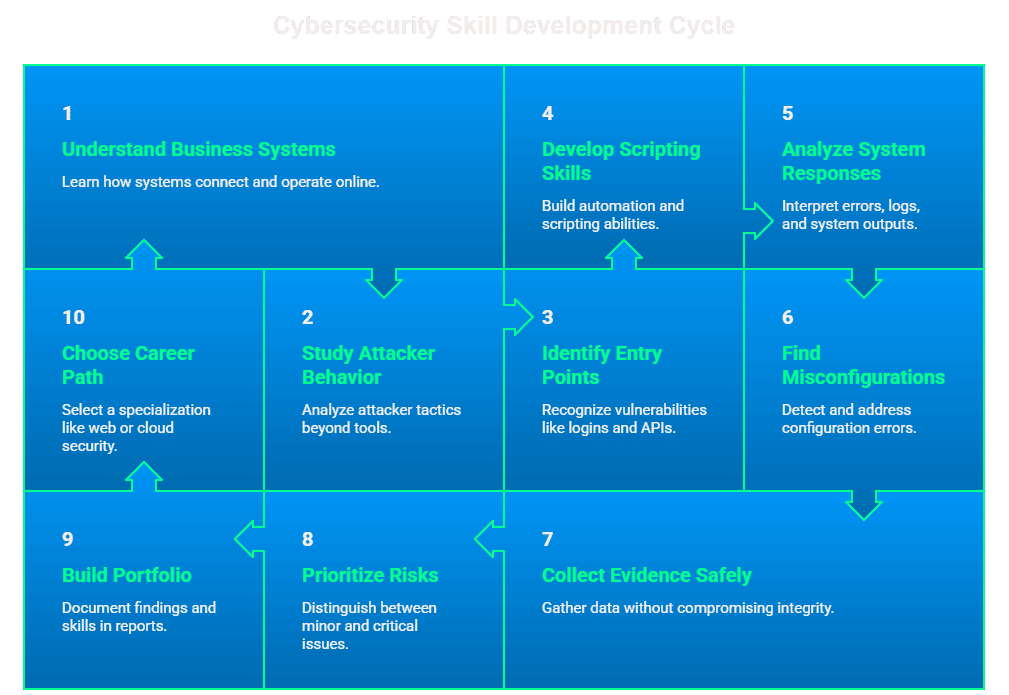
The industry roadmap for ethical hacking and penetration testing starts with cybersecurity fundamentals and gradually moves into hands-on testing, reporting, certifications, and specialization.
This path helps beginners grow step by step.
- Learn how business systems connect and work online.
- Understand attacker behavior beyond tools.
- Study entry points like logins, APIs, servers, email, and cloud.
- Build basic scripting and automation skills.
- Learn to read errors, logs, and system responses.
- Practice finding misconfigurations and access gaps.
- Collect evidence safely without harming data.
- Separate minor issues from critical risks.
- Build a portfolio with lab reports and sample findings.
- Choose a path like web, cloud, SOC, red team, or consulting.
Read also: What Are Social Engineering Attacks?
Conclusion
Ethical hacking and penetration testing help learners and organizations understand cyber risks in a practical way. Ethical hacking is the broader practice, while penetration testing is a focused method used to validate weaknesses.
Explore SecuRetain's learning platform and our all courses to build practical knowledge in cybersecurity, compliance, risk management, audit, business continuity, disaster recovery, fraud management, and employee awareness training.
You can also visit our website to explore how SecuRetain helps professionals and organizations strengthen skills, improve awareness, and support continuous learning in a structured and scalable way.
FAQ's
Ethical hacking is the legal practice of finding and reporting security weaknesses with permission.
Penetration testing is a focused security test that checks whether specific systems, applications, or networks have exploitable weaknesses.
Yes, penetration testing is one part of ethical hacking. Ethical hacking is broader and may include many forms of authorized security testing.
Yes, beginners can start with networking, Linux, cybersecurity basics, web security, and legal lab practice.
Organizations can use ethical hacking concepts to train employees, IT teams, SOC teams, and compliance teams on real cyber risks and safe security practices.
Build practical ethical hacking skills
Explore SecuRetain courses that help learners understand ethical hacking, penetration testing, vulnerability analysis, reporting, and cybersecurity risk reduction.
Related reads
Keep exploring
 Ethical Hacking
Tools used by ethical hackers help security professionals identify vulnerabilities, test defenses, analyze risks, and strengthen systems.
 Cybersecurity
A vulnerability report is a structured security document that explains weaknesses found during ethical hacking or vulnerability assessment.
 Ethical Hacking
Basic penetration testing is an authorized security assessment that helps identify, validate, and report security weaknesses before attackers can misuse them.