How Ethical Hackers Secure Networks Before Attackers Exploit Weaknesses

- Published:
- Last Updated:
Security teams need to find network weaknesses before attackers do. Ethical hackers support this by safely testing corporate systems, access controls, applications, users, devices, and security processes under approved scope. This helps organizations reduce cyber risk, improve security controls, support compliance, and build stronger security awareness before an actual attack occurs.
Overview
Ethical hackers secure organizations by finding weak entry points in networks, systems, applications, users, vendors, and processes before attackers exploit them. These gaps may include weak credentials, unpatched software, exposed systems, insecure remote access, cloud misconfigurations, unsafe Wi-Fi, and poor access controls.
For risk, compliance, IT, audit, and security teams, ethical hacking is more than a technical test. It is a business risk management activity that helps prevent unauthorized access, data exposure, ransomware, downtime, regulatory issues, and loss of trust.
This article explains what ethical hacking means for corporate network security, why ethical hackers are important, how they secure networks before attacks, what areas they test, and what business risks organizations should monitor.
Ethical hacking helps organizations identify real security gaps before they become incidents by translating technical vulnerabilities into business risks that leadership can clearly understand, as highlighted by Vytautas Kaziukonis in his Forbes Tech Council article "Ethical Hacking: What Companies Should Know-And How To Do It" published on March 6, 2025.
Key Findings
- Ethical hackers identify weak points in networks, applications, cloud systems, Wi-Fi, access controls, vendors, and employee security behavior.
- They find risks such as weak passwords, unpatched systems, insecure remote access, vendor access gaps, and cloud misconfigurations.
- Ethical hacking converts technical weaknesses into business risks that leadership, compliance, audit, and risk teams can understand.
- Basic pentesting and structured testing help organizations move from assumptions to evidence-based security improvement.
- Ethical hacking works best when findings are documented, fixed, retested, and supported with employee awareness and corporate training.
Recommendations
Organizations should use ethical hacking as part of a continuous security improvement process, not as a one-time test.
To improve network security before attacks, organizations should:
- Define clear testing scope, permission, timelines, and rules before any ethical hacking activity.
- Test both external and internal network areas to understand complete exposure.
- Review access controls, passwords, MFA, user roles, and privileged accounts regularly.
- Connect ethical hacking findings with risk management, compliance, audit evidence, and employee training.
- Retest fixed issues to confirm that remediation has reduced the actual risk.
- Use ethical hacking reports to prioritize actions based on business impact, not only technical severity.
Proactive cybersecurity is essential in today's AI-driven threat landscape, where attackers use automation to find vulnerabilities faster than traditional defenses can respond. Chuck Brooks emphasizes this in his Forbes article "Why Proactive Cybersecurity Is Essential In The AI Era" (published March 23, 2026).
What Does Ethical Hacking Mean for Corporate Network Security?
Ethical hacking means legally testing corporate networks to find security weaknesses before attackers can misuse them.
Here is how ethical hacking supports stronger corporate network security:
- Ethical hackers work with permission, defined scope, and approved testing rules.
- They identify weaknesses in systems, applications, users, devices, and access controls.
- They help organizations understand whether security controls are actually working.
- They turn technical issues into business risks that leadership can understand.
- They support risk management, compliance, audit readiness, and security awareness.
- They help teams fix weaknesses before they become real incidents.
Corporate networks are connected to employees, cloud tools, vendors, applications, databases, and business systems. If one part is weak, attackers may use it as an entry point. Ethical hackers test these weak areas safely so organizations can close gaps early.
Read more: How Ethical Hackers Protect Systems
Why Is an Ethical Hacker Important for Corporates?
An ethical hacker is important for corporations because they help detect real security gaps before those gaps turn into data loss, downtime, fraud, or compliance issues.
Below are the main reasons corporates need ethical hackers because they:
- Find weaknesses automated tools may miss.
- Test whether attackers can access sensitive systems.
- Reduce credential theft and unauthorized access risks.
- Check if employees, systems, and vendors follow security controls.
- Support audits with documented testing evidence.
- Help leadership prioritize urgent risks.
- Improve awareness by showing real attack scenarios.
Many organizations invest in security tools but still remain exposed because tools alone cannot always confirm real business impact. Ethical hackers help bridge that gap by safely validating whether a weakness can actually lead to risk.
For example, a vulnerability scan may show outdated software, but an ethical hacker can explain whether that outdated software could expose customer data, allow internal movement, or interrupt business operations.
Organizations can connect these findings with Cybersecurity Awareness Programs for Organizations 2026 to improve employee behavior and strengthen security culture.
Read more: How Ethical Hacking Helps Identify Credential Theft Risks
How Do Ethical Hackers Secure Corporate Networks?
Ethical hackers secure corporate networks by following a structured testing process that finds, validates, reports, and helps fix security weaknesses.
The table below shows how ethical hackers usually move from planning to remediation:
| Phase | What Ethical Hackers Do | Business Value |
|---|---|---|
| Planning and Scope | Define permission, systems, timelines, and testing rules | Prevents legal and operational confusion |
| Reconnaissance | Review approved public and internal information | Shows what attackers may see first |
| Discovery and Scanning | Identify systems, services, ports, and possible weaknesses | Improves security visibility |
| Vulnerability Analysis | Review findings and remove false positives | Helps teams focus on real risks |
| Controlled Validation | Safely test approved weaknesses | Shows actual business impact |
| Reporting | Document evidence, severity, and remediation steps | Supports audit and compliance evidence |
| Retesting | Verify whether fixes are working | Confirms risk reduction |
Ethical hackers also reduce attack paths. An attack path is the route an attacker could use to move from one weak point to a valuable system. For example, an attacker may start with a weak password, access an employee account, move into internal systems, and reach sensitive data.
Ethical hackers help reduce these paths by testing:
- Weak or reused passwords
- Missing multi-factor authentication
- Exposed remote access services
- Unpatched systems
- Poor firewall rules
- Weak network segmentation
- Risky vendor access
- Misconfigured cloud accounts
- Insecure web applications
- Poor monitoring and alerting
After testing, ethical hackers provide a report that explains what was found, why it matters, how severe it is, and how to fix it. This report is useful for IT teams, risk owners, auditors, compliance teams, and leadership.
Readers can explore What Are Social Engineering Attacks? to understand how attackers target human behavior.
What Areas of a Corporate Network Do Ethical Hackers Test?
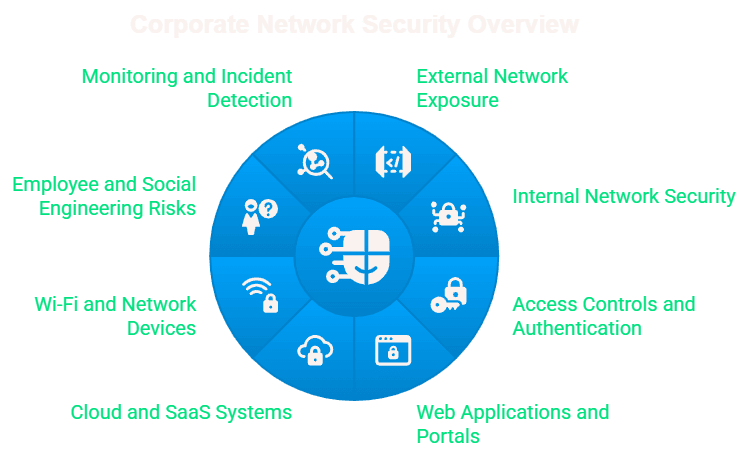
Ethical hackers test corporate network areas such as external systems, internal networks, applications, cloud tools, access controls, Wi-Fi, users, vendors, and monitoring systems.
These are the main areas ethical hackers usually review:
- External Network Exposure: Websites, VPNs, email servers, remote login portals, admin panels, open ports, and exposed services.
- Internal networks: Internal servers, shared folders, user permissions, segmentation gaps, and lateral movement paths.
- Access controls: Weak passwords, missing MFA, excessive privileges, dormant accounts, shared credentials, and poor role-based access.
- Web applications: Login pages, dashboards, forms, customer portals, broken access control, session issues, and exposed data.
- Cloud and SaaS tools: Cloud permissions, public storage exposure, identity settings, unsafe integrations, admin access, and data-sharing risks.
- Wi-Fi and network devices: Weak encryption, default credentials, poor guest network separation, outdated firmware, and insecure device settings.
- Employee security behavior: Phishing exposure, weak awareness, unsafe password habits, credential sharing, and poor incident reporting.
- Monitoring and incident detection: Security logs, alerts, SIEM tools, detection rules, incident response gaps, suspicious activity tracking, and whether teams can identify attacks quickly.
Practical example:
If an employee account has weak MFA and access to sensitive files, the issue becomes more than a login problem. It becomes a privacy, compliance, audit, and business risk.
Organizations must address emerging threats like cloud misconfigurations and identity-focused attacks through continuous testing. According to IBM's "Cybersecurity Trends 2026" report, which references Gartner's top cybersecurity trends for 2026 (published February 5, 2026).
What Corporate Risks Can Ethical Hackers Test?
They test corporate risks such as unauthorized access, credential theft, data exposure, ransomware entry points, vendor risk, insider threats, and weak monitoring.
These are the main business risks ethical hackers help identify:
- Unauthorized access: Can someone enter systems without permission?
- Credential theft: Can weak passwords or missing MFA expose accounts?
- Data breach: Can sensitive data be viewed or leaked?
- Ransomware entry: Can exposed systems help malware spread?
- Vendor access: Do third parties have excessive access?
- Insider threat: Can internal users misuse permissions?
- Application risk: Can web apps expose business data?
- Cloud risk: Are cloud settings or permissions unsafe?
- Compliance risk: Can weak controls create audit issues?
- Continuity risk: Can cyber gaps disrupt operations?
Read more: How AI Transforms Ethical Hacking
Conclusion
How Ethical Hackers Secure Networks is by identifying weak points before attackers can use them and helping organizations fix those gaps with clear evidence. Ethical hacking supports stronger access controls, safer systems, better monitoring, improved employee awareness, and more practical risk management.
Explore SecuRetain's learning platform and our all courses to build practical knowledge in cybersecurity, compliance, risk management, audit, business continuity, disaster recovery, fraud management, and employee awareness training.
You can also visit our website to explore how SecuRetain helps professionals and organizations strengthen skills, improve awareness, and support continuous learning in a structured and scalable way.
FAQs
Network security testing means checking systems, users, applications, and access controls to find weak points before attackers can misuse them.
Companies can secure networks by testing exposed systems, fixing weak access controls, reviewing cloud settings, improving monitoring, and training employees.
Yes, basic pentesting helps companies identify real weaknesses and understand whether those weaknesses can create business risk.
Companies should test external systems, internal networks, web applications, Wi-Fi, cloud tools, endpoints, access controls, vendors, and employee security behavior.
Employees should learn about network security risks because many attacks begin with phishing, weak passwords, unsafe links, or poor security habits.
Build practical ethical hacking skills
Explore cybersecurity courses that help learners understand network testing, access control review, reporting, remediation, and business risk reduction.
Related reads
Keep exploring
 Ethical Hacking
AI in ethical hacking helps security teams detect vulnerabilities faster, automate penetration testing tasks, analyze attack patterns, and improve risk prioritization.
 Ethical Hacking
Ethical hackers legally test networks, applications, cloud platforms, and security controls to find vulnerabilities and recommend fixes.
 Ethical Hacking
Ethical Hacking for Credential Theft Detection helps organizations identify weak passwords, exposed credentials, phishing risks, MFA gaps, and access control weaknesses.