How AI Transforms Ethical Hacking: Techniques, Benefits, and Risks

- Published:
- Last Updated:
AI in ethical hacking helps security teams detect vulnerabilities faster, automate penetration testing tasks, analyze attack patterns, and improve risk prioritization. It transforms ethical hacking from a mostly manual process into a smarter, datacentric security approach while still requiring human judgment, authorization, and ethical control.
In this article, you will learn how ethical hacking AI supports penetration testing, exploit analysis, social engineering simulations, vulnerability detection, and security decision-making. You will also understand the main benefits, risks, and ethical concerns of using AI in cybersecurity testing.
What Are AI-Powered Methodologies in Modern Penetration Testing?
AI-powered methodologies in modern penetration testing use automation, pattern detection, and intelligent analysis to improve each testing phase.
| Penetration Testing Phase | How AI Helps |
|---|---|
| Reconnaissance | Finds exposed assets, domains, services, and weak entry points faster. |
| Vulnerability Discovery | Detects known and unusual security gaps across systems. |
| Risk Prioritization | Highlights vulnerabilities most likely to cause business damage. |
| Attack Path Analysis | Shows how multiple small weaknesses can create a bigger risk. |
| Reporting | Summarizes findings, severity, and remediation steps clearly. |
AI in ethical hacking works best when combined with human validation, because context still matters in security decisions.
What Are AI-Powered Techniques for Ethical Hacking and Exploit Development?
AI-powered techniques support ethical hacking and exploit development by helping professionals understand vulnerabilities safely in authorized environments. Instead of manually checking every issue, AI can quickly analyze vulnerabilities, show possible impact areas, and help teams decide which risks need attention first.
AI can help ethical hackers by:
- Understanding vulnerability details quickly.
- Explaining how serious a security weakness is.
- Checking whether a weakness can actually be exploited.
- Supporting safe testing in approved systems.
- Connecting risks with frameworks like CVE, CVSS, MITRE ATT&CK, and OWASP.
- Helping teams study suspicious software safely.
- Creating simple reports without sharing harmful attack steps.
How to Use AI Safely in Exploit Validation
AI should be used carefully during exploit validation.
- Test only on systems where permission is given.
- Do not create or use harmful payloads.
- Stay within the approved testing scope.
- Keep testing inside a lab or controlled setup.
- Always let a human expert review AI results.
Read also: Ethical Hacking Techniques: A Complete Beginner-Friendly Guide
How Does AI Enhance Penetration Testing?
AI enhances penetration testing by improving speed, accuracy, scalability, and risk visibility across the security testing lifecycle.
- It automates repetitive tasks like scanning, sorting, and initial analysis.
- It helps identify patterns that may be missed during manual testing.
- It supports faster review of logs, alerts, and vulnerability data.
- It improves report quality by converting technical findings into clear summaries.
- It helps compare current weaknesses with known attack techniques.
- It supports continuous security validation for fast-changing environments.
How to Apply AI During Penetration Testing
- Start with defined testing scope.
- Use AI for discovery and analysis.
- Validate every important finding manually.
- Prioritize issues based on exploitability and business impact.
- Convert results into actionable remediation tasks.
AI in ethical hacking improves penetration testing only when the tester controls the process, verifies outputs, and avoids blind dependency.
Read also: Cybersecurity for Small Businesses: What Every Owner Should Know
What Is the Role of AI in Ethical Hacking?
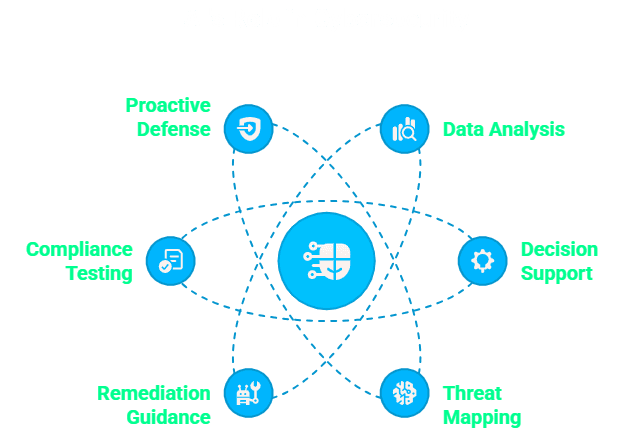
The role of AI in ethical hacking is to act as an intelligent assistant that supports testing, analysis, prioritization, and reporting.
- AI helps ethical hackers work with large volumes of security data.
- It supports faster decision-making during vulnerability assessment.
- It helps connect technical findings with likely attack scenarios.
- It improves remediation guidance by suggesting practical fixes.
- It supports compliance-driven testing by organizing evidence and reports.
- It helps teams move from reactive testing to proactive defense.
What Are the Challenges & Ethical Concerns of AI?
The biggest challenges of AI in ethical hacking include misuse, false positives, data privacy issues, bias, and overdependence on automation.
- Attackers can also use AI to improve phishing, scanning, and evasion.
- AI tools may produce false positives that waste security team time.
- Poorly trained models can miss real vulnerabilities.
- Sensitive security data may be exposed if entered into unsafe AI tools.
- Bias in training data can affect detection accuracy.
- Overreliance on AI can reduce human testing skills.
How to Manage AI Risk in Ethical Hacking
- Use approved AI tools only.
- Keep sensitive data protected.
- Validate all critical findings manually.
- Maintain audit logs for AI-assisted testing.
- Train teams on responsible AI usage.
Read also: What Is Enumeration in Ethical Hacking?
Conclusion
AI in ethical hacking should be used responsibly, only in authorized testing environments, and always with human oversight. When combined with ethical judgment, data protection, and clear governance, ethical hacking AI helps organizations find weaknesses faster, improve security decisions, and reduce real-world attack risks.
To take your learning to the next level, explore our diverse selection of courses designed to help you grow professionally. Visit our Courses page to find the perfect course for your needs.
Start your journey today with SecuRetain, where we support your path to success.
FAQs
AI in ethical hacking is used to detect vulnerabilities, analyze attack patterns, automate testing tasks, and prioritize security risks faster. It helps ethical hackers work more efficiently while still requiring human review and authorization.
No, AI cannot fully replace ethical hackers. It can support scanning, analysis, and reporting, but human experts are still needed to validate findings, understand business context, and make ethical security decisions.
AI improves penetration testing by automating repetitive tasks, identifying hidden patterns, reviewing large security data sets, and helping teams focus on high-risk vulnerabilities. This makes testing faster, more accurate, and more scalable.
The main risks include false positives, data privacy issues, misuse by attackers, biased results, and overdependence on automation. AI tools should always be used with clear governance and human validation.
AI can be safe for exploit validation when it is used only in authorized systems, controlled labs, and approved testing scopes. Ethical hackers should avoid harmful payloads and manually review every AI-generated result.
Build practical ethical hacking skills
Explore cybersecurity courses that help learners understand AI-assisted testing, vulnerability analysis, reporting, and responsible security workflows.
Related reads
Keep exploring
 Ethical Hacking
Tools used by ethical hackers help security professionals identify vulnerabilities, test defenses, analyze risks, and strengthen systems.
 Ethical Hacking
Ethical hacking techniques help security professionals identify weak points in systems, networks, applications, and human behavior before attackers can exploit them.
 Cybersecurity
A step-by-step guide to conducting vulnerability assessments safely, from scope and asset discovery to scanning, prioritization, remediation, and reassessment.