How to Avoid Cyber Attacks: A Complete Guide for Organizations

- Published:
- Last Updated:
To avoid cyber attacks, organizations need more than antivirus tools or one-time training. They need strong cybersecurity controls, employee awareness, regular control testing, continuous monitoring, audit-ready evidence, and clear remediation tracking. The goal is not only to block attacks, but to prove that security controls are working.
What Does It Really Mean to Avoid Cyber Attacks?
Avoiding cyber attacks means reducing the chances of unauthorized access, data theft, fraud, ransomware, business disruption, and compliance failure. It does not mean risk becomes zero. It means the organization has practical controls that make attacks harder, easier to detect, and faster to contain.
For enterprises, startups, healthcare organizations, financial services companies, technology companies, education institutions, and public sector teams, cyberattack prevention should include people, process, technology, and governance.
Employees need awareness. IT teams need secure configurations. SOC analysts need alerts. Compliance and audit teams need evidence. Risk teams need visibility into control gaps. This is why topics like cybersecurity for small businesses, social engineering attacks, and cybersecurity awareness programs are directly connected to attack prevention.
Which Controls Reduce Cyber Risk First?
The most effective cybersecurity controls are usually the ones that reduce common attack paths. Start with these:
- Multi-factor authentication for email, cloud, VPN, admin, and financial systems.
- Strong password practices and password managers.
- Patch management for systems, applications, browsers, and plugins.
- Regular backups with tested recovery.
- Least privilege access and periodic access reviews.
- Email security, phishing protection, and reporting channels.
- Endpoint protection and device hardening.
- Secure Wi-Fi, firewall rules, and network segmentation.
- Employee training on phishing, fake invoices, OTP fraud, and unsafe links.
- Vulnerability scanning, secure configuration checks, and remediation tracking.
These controls should be mapped to business risks. For example, ransomware risk connects to backups, patching, access control, endpoint security, and user awareness. Payment fraud risk connects to approval workflows, email security, and fraud awareness. Teams can strengthen this foundation through cybersecurity certification courses and corporate cybersecurity training.
What Is the Difference Between Control Design, Control Testing, and Control Monitoring?
Many organizations create controls but do not check whether they actually work. That is where cyber risk grows silently.
| Area | Meaning | Example |
|---|---|---|
| Control Design | How the control is planned | MFA must be enabled for all admin accounts |
| Control Testing | Checking whether the control works | Review admin accounts and confirm MFA is active |
| Control Monitoring | Ongoing tracking of control performance | Alert when MFA is disabled or a new admin is added |
- Control design answers, "Is the control properly defined?"
- Control testing answers, "Did the control work when checked?"
- Control monitoring answers, "Is the control still working today?"
This distinction is important for CISOs, IT security leaders, compliance officers, internal audit teams, and GRC professionals because cyberattack prevention must be measurable, not assumed.
Read also: Cybersecurity for Small Businesses: What Every Owner Should Know
How Should Organizations Collect Control Evidence?
Control evidence proves that a cybersecurity control exists and is working. It also supports audit readiness and regulatory reviews.
Useful evidence includes:
- Screenshots of MFA settings, access controls, and security policies.
- System logs showing alerts, blocked attempts, or login activity.
- Vulnerability scan reports with remediation status.
- Training completion records and phishing simulation results.
- Backup success reports and recovery test results.
- Change approval records for security configurations.
- Incident tickets, investigation notes, and closure evidence.
- Access review sign-offs and user deactivation records.
Good evidence should show the control owner, date, scope, system name, result, exception, and action taken. Avoid collecting random screenshots without context. Evidence should be linked to a control, risk, asset, and audit requirement.
For technical teams, how to conduct vulnerability assessment safely is a useful supporting topic because vulnerability evidence helps prioritize remediation.
Read also: What is Ethical Hacking? A Beginner's Guide to Cybersecurity
How Do You Measure Control Effectiveness?
Control effectiveness measures whether a control reduces risk in real conditions. A control may exist on paper but still fail in practice.
Use these indicators:
- How many systems are covered by the control?
- How many exceptions are open?
- How often does the control fail?
- How quickly are failed controls remediated?
- Are critical assets protected first?
- Are incidents reducing over time?
- Are users reporting suspicious activity faster?
- Are audit findings decreasing?
For example, employee training is more effective when phishing click rates reduce and reporting rates improve. Patch management is more effective when critical vulnerabilities are fixed within defined timelines. Access control is more effective when inactive users and excessive privileges are removed quickly.
What Common Control Testing Mistakes Weaken Cyber Defenses?
Control testing often fails when teams treat it as a checklist activity.
Common mistakes include:
- Testing only once a year before an audit.
- Checking policy existence but not operating effectiveness.
- Ignoring high-risk systems and privileged users.
- Not validating whether remediation actually worked.
- Accepting screenshots without timestamps or scope.
- Failing to assign control owners.
- Not tracking repeated failures or overdue actions.
- Treating awareness training completion as proof of behavior change.
Cybersecurity teams should combine technical validation with process review. For deeper learning, teams can refer to how to perform basic pentesting step by step, tools used by ethical hackers, and top ethical hacking techniques.
Read also: Cybersecurity Awareness Programs for Organizations 2026
What Should You Do When a Control Fails?
A failed control is not just an audit issue. It may be a real attack opportunity.
When a control fails:
- 1.Record the failure with evidence.
- 2.Identify the affected asset, process, user group, or system.
- 3.Rate the risk based on impact and likelihood.
- 4.Assign an owner and remediation deadline.
- 5.Apply a fix or compensating control.
- 6.Retest the control after remediation.
- 7.Track recurring failures for root cause analysis.
For example, if MFA is missing for admin users, the immediate action is to enable MFA or restrict admin access until fixed. If backups are failing, the team must restore backup jobs and test recovery. If phishing reports are low, HR and L&D teams should improve role-based awareness training through structured cybersecurity training programs.
Internal Controls Management Checklist to Avoid Cyber Attacks
Use this checklist as a starting point:
- Identify critical assets, users, systems, and data.
- Map top cyber risks to preventive, detective, and corrective controls.
- Enable MFA and strong access management.
- Run regular vulnerability assessments.
- Train employees on phishing and social engineering.
- Monitor logs, alerts, and unusual activity.
- Test backups and recovery plans.
- Review third-party and vendor access.
- Collect control evidence continuously.
- Track remediation until closure.
- Review control effectiveness with leadership.
- Update controls when threats, systems, or regulations change.
Teams building technical knowledge can also explore ethical hacking beginners guide, step-by-step ethical hacking, ethical hacking roadmap, essential skills required for ethical hacking, and legal boundaries of ethical hacking.
Conclusion
Avoiding cyber attacks requires a practical, continuous, and evidence-based approach. Organizations should not rely only on tools or policies. They should design strong controls, test them, monitor them, collect evidence, and fix failures quickly. When cybersecurity, GRC, audit readiness, and employee awareness work together, cyber risk becomes easier to manage and harder for attackers to exploit.
Explore SecuRetain's learning platform and our all courses to build practical knowledge in cybersecurity, compliance, risk management, audit, business continuity, disaster recovery, fraud management, and employee awareness training.
You can also visit our website to explore how SecuRetain helps professionals and organizations strengthen skills, improve awareness, and support continuous learning in a structured and scalable way.
FAQs
The best way is to combine strong technical controls, employee awareness, regular testing, continuous monitoring, and fast remediation. No single tool can prevent every attack.
Employees can help by reporting suspicious emails, avoiding unknown links, using strong passwords, enabling MFA, protecting devices, and verifying payment or data requests before acting.
Cybersecurity controls are safeguards that reduce cyber risk. They include access controls, backups, monitoring, patching, endpoint protection, employee training, and incident response processes.
High-risk controls should be tested regularly, not only before audits. The frequency depends on risk level, system criticality, regulatory needs, and recent changes.
The failure should be documented, assigned to an owner, remediated, retested, and tracked until closure. Repeated failures should trigger root cause analysis.
Reduce cyber risk with practical learning
Explore cybersecurity courses that help teams understand control design, vulnerability assessment, employee awareness, and security monitoring.
Related reads
Keep exploring
 Cybersecurity
Cybersecurity awareness programs help organizations educate their teams to recognize and prevent digital threats like phishing, ransomware, and social engineering.
 Cybersecurity
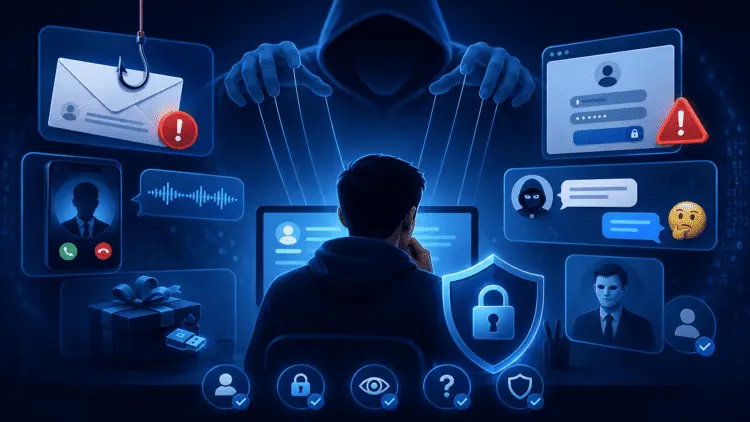
Social Engineering Attacks manipulate people into sharing sensitive information, clicking harmful links, or taking unsafe actions through trust, urgency, fear, or curiosity.
 DPDP
DPDPUnderstand India's Personal Data Protection Act, including its scope, key terms, business duties, individual rights, enforcement, penalties, and practical DPDP compliance steps.