What Are Man-in-the-Middle Attacks and How Can Businesses Prevent Them?

- Published:
- Last Updated:
Man-in-the-Middle Attacks happen when an attacker secretly intercepts, monitors, or changes communication between users, applications, networks, or systems. In this guide, readers will learn what MITM attacks are, how they work, common types and techniques, why they create business risk, and how organizations can prevent them through encryption, secure Wi-Fi, certificate validation, monitoring, awareness training, and security assessments.
What Is a Man-in-the-Middle (MITM) Attack?
A Man-in-the-Middle attack is a cyberattack where an attacker secretly intercepts communication between two trusted parties. The attacker may read, capture, redirect, or change the information being exchanged, often without the user or business system immediately noticing.
In a normal connection, a user communicates directly with a website, application, cloud service, or internal business system. In a MITM attack, the attacker positions themselves between both sides and acts like a silent middle layer. For example, an employee uses public Wi-Fi to open a business app. If the Wi-Fi is not secure and the app does not use strong protection, an attacker may try to see or steal the information being shared.
What Are the Different Types of Man-in-the-Middle Attacks?
MITM attacks do not always look the same. Some happen through weak networks, while others target browsers, certificates, sessions, or email communication.
Here are the main types of MITM attacks businesses should know:
- Wi-Fi Interception: Attackers monitor data on unsafe or fake Wi-Fi networks. This can expose login details, business data, and sensitive communication.
- DNS Spoofing: Users are redirected to fake or harmful websites without realizing it. This can lead to fraud, data theft, or fake login page attacks.
- ARP Spoofing: Attackers redirect network traffic inside a local network. This may allow them to see or capture internal communication.
- HTTPS/TLS Interception: Secure connections are weakened or misused by attackers. This can reduce trust in encrypted communication and expose sensitive data.
- Email Hijacking: Attackers intercept or change business emails. This can lead to invoice fraud, payment manipulation, or data leakage.
- Session Hijacking: Attackers steal active session tokens from users. This can allow unauthorized access to business accounts.
- Man-in-the-Browser: Malware changes or monitors browser activity. This can lead to financial fraud, data theft, or unauthorized transaction changes.
Read more: How to Avoid Cyber Attacks
What Techniques Do Attackers Use in Man-in-the-Middle Attacks?
MITM attacking techniques usually rely on one idea: breaking trust in communication. The attacker wants the user, device, browser, or application to believe the connection is believable.
Common techniques include:
- Creating fake Wi-Fi access points that look trustworthy
- Redirecting traffic to a malicious destination
- Exploiting weak or missing certificate validation
- Capturing session cookies or tokens
- Manipulating DNS responses
- Intercepting poorly protected application traffic
- Using malware to change browser behavior
- Downgrading or weakening secure connections where controls are poor
Why Are MITM Attacks a Serious Business Risk?
These kinds of attacks are serious because they can expose sensitive data, steal credentials, manipulate transactions, disrupt communication, and create compliance or audit issues.
Business impact can include:
- Exposure of customer or employee data
- Theft of usernames, passwords, tokens, or session details
- Manipulated payment instructions or invoices
- Unauthorized access to cloud applications
- Compromised vendor communication
- Loss of trust in digital platforms
- Compliance gaps related to data protection
- Poor audit evidence for encryption and access controls
Read more: What Is a Zero-Day in Ethical Hacking?
How Do Man-in-the-Middle Attacks Work?
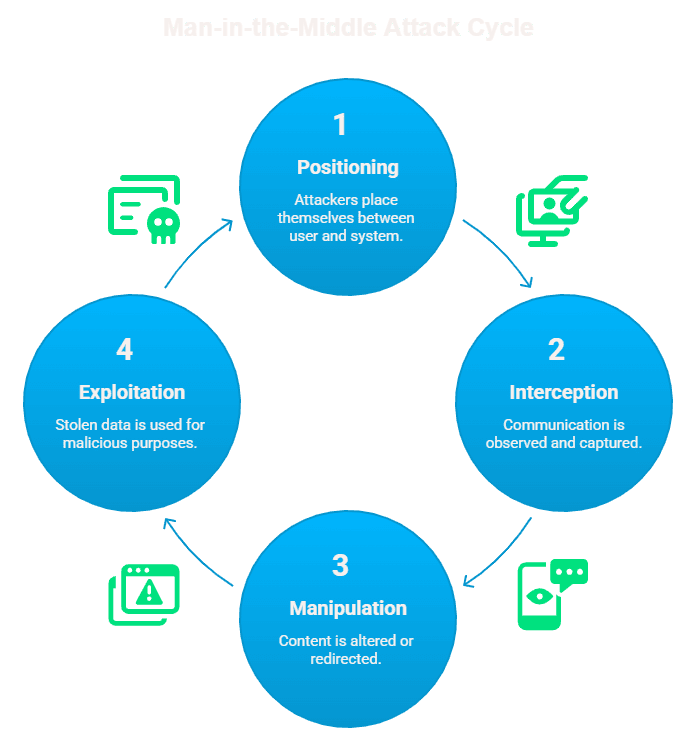
Man-in-the-Middle Attacks usually work in three stages: positioning, interception, and misuse. The attacker first gets between the user and the service, then captures or changes traffic, and finally uses the information for fraud, account access, or further attacks.
A MITM attack typically follows this flow:
- 1.Positioning: Attackers place themselves between the user and the intended system. This may happen through unsafe Wi-Fi, spoofed network communication, malicious redirects, or compromised devices.
- 2.Interception: Communication is observed or captured by the attacker. This can include credentials, cookies, tokens, messages, or application requests.
- 3.Manipulation: At this stage, the attacker may change content, redirect users, replace payment details, or inject malicious instructions.
- 4.Exploitation: Stolen or altered data may be used for account takeover, fraud, data theft, or further system access.
How Can Businesses Prevent Man-in-the-Middle Attacks?
Businesses can prevent Man-in-the-Middle Attacks by applying encryption, validating certificates, securing Wi-Fi, using trusted DNS protection, applying strong authentication, updating systems, monitoring network activity, and training employees to recognize unsafe connections and certificate warnings.
Key prevention steps include:
- Use HTTPS with secure TLS configurations.
- Validate certificates and avoid untrusted certificate warnings.
- Use secure Wi-Fi such as WPA2-Enterprise or WPA3.
- Separate guest Wi-Fi from internal systems.
- Use VPNs on remote or untrusted networks.
- Apply DNS security controls and monitor redirects.
- Use phishing-resistant MFA where needed.
- Keep browsers, devices, routers, and apps updated.
- Monitor unusual logins, sessions, and network traffic.
- Train employees to avoid unsafe Wi-Fi and risky certificate bypasses.
How Can a Security Assessment Detect MITM Risks?
A security assessment helps organizations find weak points that could allow attackers to intercept or change communication. Instead of assuming systems are safe, it tests whether security controls are working properly.
A MITM-focused assessment may include:
- Wi-Fi security review
- Rogue access point detection
- TLS and certificate checks
- Web and mobile application traffic testing
- DNS security review
- Session management testing
- Network segmentation review
- Endpoint and browser configuration checks
Read also: What Is Enumeration in Ethical Hacking?
How Is a Man-in-the-Middle Attack Different from Phishing?
A Man-in-the-Middle attack intercepts communication between two parties, while phishing tricks users into revealing information or taking unsafe action. Both can lead to credential theft, but they use different methods and require different controls.
Here's how MITM attacks differ from phishing:
| Area | Man-in-the-Middle Attack | Phishing |
|---|---|---|
| Main Method | Intercepts communication | Tricks the user |
| Primary Target | Network, session, traffic, certificates | Human behavior and trust |
| Common Result | Data interception or session theft | Credential theft or malware |
| Prevention Focus | Encryption, certificates, secure networks | Awareness, email security, MFA |
| Business Control | Security assessment and monitoring | Training and phishing simulation |
Conclusion
Man-in-the-Middle Attacks are a serious business risk because they can expose data, credentials, sessions, and sensitive communication without obvious warning signs. Strong MITM Attack Prevention requires secure technology, employee awareness, regular assessments, and proper documentation.
Explore SecuRetain's learning platform and our all courses to build practical knowledge in cybersecurity, compliance, risk management, audit, business continuity, disaster recovery, fraud management, and employee awareness training.
You can also visit our website to explore how SecuRetain helps professionals and organizations strengthen skills, improve awareness, and support continuous learning in a structured and scalable way.
FAQ's
A Man-in-the-Middle attack means an attacker secretly intercepts communication between two trusted parties, such as a user and a business application.
MITM attacks are dangerous because they can expose passwords, customer data, payment details, business emails, and internal communication.
MITM attacks commonly happen on unsafe public Wi-Fi, poorly secured networks, fake websites, weak applications, and systems with poor certificate validation.
The best way to prevent MITM attacks is to use encryption, secure Wi-Fi, trusted VPN access, strong authentication, certificate validation, monitoring, and employee awareness training.
Yes, security testing can find MITM risks by checking Wi-Fi security, application traffic, TLS settings, DNS controls, session handling, and certificate validation.
Build practical cybersecurity prevention skills
Explore cybersecurity courses that help teams understand network risks, secure communication, monitoring, and business-focused security controls.
Related reads
Keep exploring
 Ethical Hacking
A zero-day is an unknown or unpatched vulnerability; learn its lifecycle, discovery methods, and how ethical hackers handle it responsibly.
 Cybersecurity
To avoid cyber attacks, organizations need strong cybersecurity controls, employee awareness, regular control testing, continuous monitoring, and remediation tracking.
 Cybersecurity
Wi-Fi Penetration Testing is an authorized wireless security assessment that checks business Wi-Fi networks for weak encryption, rogue access points, insecure authentication, guest network exposure, and segmentation gaps.