What Is Enumeration in Ethical Hacking? Meaning and Process Explained

- Published:
- Last Updated:
Enumeration in ethical hacking is the process of collecting detailed information about users, systems, services, networks, and applications after initial discovery. It helps ethical hackers understand what is exposed, how systems respond, and where security risks may exist before vulnerability testing begins. In this guide, readers will learn what enumeration means, why it matters, common techniques, prevention methods, useful tool categories, and how enumeration differs from scanning and footprinting.
What is Enumeration in Ethical Hacking?
Enumeration in ethical hacking means gathering deeper technical details from approved systems during a security assessment. It goes beyond basic discovery by identifying visible users, services, ports, software versions, shared resources, application paths, and configuration details.
Key points to understand:
- It is performed after initial footprinting or scanning.
- It helps reveal what systems and services are actually exposed.
- It may identify usernames, service banners, DNS records, or application details.
- It supports vulnerability testing by giving testers more accurate information.
- It must always follow legal authorization and defined testing scope.
- It helps organizations reduce unnecessary information disclosure.
What Are the Common Enumeration Techniques?
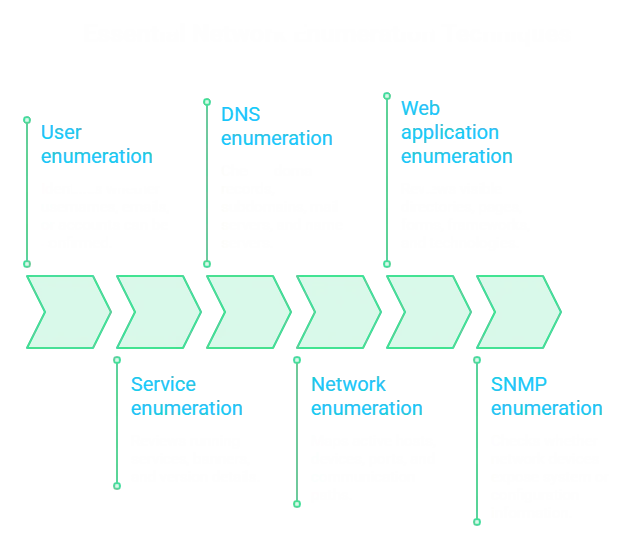
Enumeration techniques focus on collecting structured details from systems, networks, domains, and applications. Each technique helps ethical hackers understand a different part of the attack surface.
Common techniques include:
- User enumeration: Identifies whether usernames, emails, or accounts can be confirmed.
- Service enumeration: Reviews running services, banners, and version details.
- DNS enumeration: Checks domain records, subdomains, mail servers, and name servers.
- Network enumeration: Maps active hosts, devices, ports, and communication paths.
- Web application enumeration: Reviews visible directories, pages, forms, frameworks, and technologies.
- SNMP enumeration: Checks whether network devices expose system or configuration information.
What Are the Main Types of Enumeration in Ethical Hacking?
The main types of enumeration in ethical hacking can be grouped by the information being collected. This makes the process easier to understand and document.
Important types include:
- Account enumeration: Checks whether login or reset flows reveal valid users.
- Host enumeration: Identifies active systems and reachable devices.
- Port enumeration: Reviews open ports and exposed services.
- Application enumeration: Identifies visible paths, forms, technologies, and public files.
- Directory enumeration: Finds accessible folders or files that may not be intended for public access.
- Protocol enumeration: Reviews services such as DNS, SMB, SMTP, LDAP, or SNMP for exposed details.
Read also: Ethical Hacking Career Path Step by Step
How Can Organizations Prevent Enumeration Attacks?
Organizations can prevent enumeration attacks by reducing unnecessary information exposure and improving secure configuration. The goal is to make systems reveal only what is required for normal business use.
Practical prevention steps include:
- Use generic error messages on login and password reset pages.
- Avoid confirming whether a username or email address exists.
- Disable unused ports, services, and public directories.
- Hide or limit software version details where possible.
- Apply multi-factor authentication and strong password policies.
- Restrict access to administrative panels and sensitive endpoints.
- Monitor repeated failed attempts, scanning activity, and unusual requests.
- Keep applications, servers, and network services updated.
Read also: How to Start Ethical Hacking for Beginners
What Are Key Tools Used for Enumeration?
Enumeration tools help ethical hackers collect information during authorized assessments. These tools should be used only in approved environments, internal labs, or legal security tests.
Common tool categories include:
- Network discovery tools for identifying active hosts and reachable systems.
- Port scanning tools for reviewing open ports and exposed services.
- Service detection tools for identifying software names and versions.
- DNS lookup tools for reviewing domain records and subdomains.
- Web testing tools for checking application paths, forms, and technologies.
- Manual validation methods for confirming findings and reducing false positives.
Read also: Is Ethical Hacking a Good Career
How Is Enumeration Different from Scanning and Footprinting?
Enumeration, scanning, and footprinting are connected, but they are not the same. They usually appear at different stages of a security testing process.
| Concept | What It Means | Main Purpose |
|---|---|---|
| Footprinting | Broad information gathering from public or approved sources | Understand the target background |
| Scanning | Identifying live hosts, ports, and services | Find reachable systems |
| Enumeration | Collecting deeper user, service, system, and application details | Understand exposed information |
| Vulnerability testing | Checking for known weaknesses and risky configurations | Prioritize remediation |
Enumeration acts as a bridge between discovery and vulnerability testing. It turns basic visibility into a useful security context.
Conclusion
Enumeration in ethical hacking is a key step that helps security teams understand what information is exposed before deeper testing begins. It reveals details about users, systems, services, applications, domains, and configurations that may create security risk.
To take your learning to the next level, explore our diverse selection of courses designed to help you grow professionally. Visit our Courses page to find the perfect course for your needs.
Start your journey today with SecuRetain, where we support your path to success.
FAQs
Enumeration in ethical hacking is the process of collecting detailed information about users, systems, services, networks, and applications after initial discovery.
Enumeration is important because it helps ethical hackers understand exposed systems, visible services, user details, and possible security risks before vulnerability testing.
Common enumeration techniques include user enumeration, service enumeration, DNS enumeration, network enumeration, web application enumeration, and SNMP enumeration.
Organizations can prevent enumeration attacks by using generic error messages, disabling unused services, hiding version details, applying MFA, and monitoring unusual activity.
Scanning identifies live hosts, ports, and services, while enumeration collects deeper details about users, systems, services, applications, and configurations.
Learn enumeration with proper security context
Explore cybersecurity courses that help learners connect discovery, enumeration, validation, and reporting into a responsible testing workflow.
Related reads
Keep exploring
 Ethical Hacking
Ethical hacking is the authorized practice of testing systems, networks, applications, and security processes to find weaknesses before attackers exploit them.
 Ethical Hacking
The scope of ethical hacking is growing because organizations need trained professionals to find vulnerabilities before attackers do.
 Ethical Hacking
Tools used by ethical hackers help security professionals identify vulnerabilities, test defenses, analyze risks, and strengthen systems.