What Is a Third-Party Risk Assessment? A Complete Vendor Risk Guide

- Published:
- Last Updated:
A third-party risk assessment is a structured review of risks created by vendors, suppliers, contractors and service providers. It helps businesses evaluate security, compliance, data privacy, operational, financial, and reputational exposure before approving a vendor relationship.
Overview
A third-party risk assessment helps organizations understand whether an external vendor can safely support operations, protect sensitive data, meet compliance expectations, and continue services without creating avoidable risk. Michael Rasmussen, in "Proactive Third-Party Risk Management: A Governance-Based Strategy," IBM, March 26, 2025, explains the need for a governance-based approach to third-party risk because vendor risk cannot be managed only through basic reviews or one-time questionnaires.
Businesses rely on vendors for cloud tools, payroll, IT support, data processing, and professional services. These relationships create shared risk because vendor weaknesses can affect the company that hires them. A strong assessment should classify vendor risk, review data access, check controls, request evidence, score risk, and monitor vendors.
Key Findings
Vendor risk should be managed based on data access, business criticality, and control strength, not only through a basic questionnaire.
- High-risk vendors need deeper review.
- Data and system access decide assessment depth.
- Evidence review matters for sensitive data.
- Risk should be reassessed after major changes.
- Training helps teams make better decisions.
What Is A Third-Party Risk Assessment?
Third-party vendor risk assessment means evaluating an external vendor's security, compliance, operational, financial, and reputational risks before or during a business relationship. Monica Landen, in "Why Vendors Are Not the Only Problem with Third-Party Risk Management," Forbes Technology Council, October 15, 2025, highlights that third-party risk also comes from weak internal oversight, access decisions, and governance gaps.
It helps businesses understand whether a vendor can safely handle sensitive data, access systems, meet service expectations, and follow required controls. The main purpose is to identify vendor-related risks early and manage them before they affect business operations.
Why Are Third-Party Vendor Risk Assessments Important?
Third-party vendor risk assessments are important because vendors can create security, privacy, compliance, financial, operational, and reputational risks for the organization that uses them.
These assessments help businesses:
- Identify risky vendors before onboarding
- Review security and privacy controls
- Reduce operational dependency risk
- Improve contracts and service expectations
- Keep evidence for governance reviews
- Prioritize high-risk vendors for deeper checks
For example, if a vendor handles login data or customer records, the business should check how that vendor manages access, encryption, backups, incidents, and data deletion.
Read more: What Are the 5 P's of Risk Management?
What Does a Third-Party Risk Assessment Involve?
A third-party risk assessment involves collecting vendor details, reviewing risk areas, validating controls, scoring risk, documenting evidence, and deciding whether the vendor should be approved, rejected, monitored, or remediated.
| Assessment Area | What It Checks | Why It Matters |
|---|---|---|
| Cybersecurity | MFA, encryption, access control, monitoring, incident response | Reduces breach and data exposure risk |
| Privacy | Data collection, storage, sharing, retention, deletion | Supports responsible data handling |
| Compliance | Policies, certifications, audit evidence, regulatory alignment | Helps with audit readiness |
| Operational Risk | Service reliability, support, continuity, recovery | Reduces disruption risk |
| Financial Risk | Vendor stability and dependency | Helps avoid business interruption |
| Legal Risk | Contracts, liability, confidentiality, data terms | Protects business accountability |
| Reputation Risk | Service failures, public issues, poor practices | Protects brand trust |
When Should Businesses Perform a Vendor Risk Assessment?
Businesses should perform a vendor risk assessment before onboarding, before sharing sensitive data, during renewals, after major changes, after incidents, and regularly for high-risk vendors. Michael Campbell, in "Evolving from Third-Party Risk Management to Third-Party Resilience," Forbes Technology Council, March 31, 2026, highlights the need to move beyond vendor risk management and prepare for disruptions, vendor failures, and recovery.
Vendor risk changes over time. A vendor may start as low risk but become more important later if they receive more data, connect to internal systems, or support critical operations.
Perform the assessment:
- Before signing a contract
- Before giving system access
- Before sharing sensitive data
- During annual vendor reviews
- During contract renewal
- After a security incident or service outage
- After scope, data, or system access changes
- Before offboarding or ending a relationship
What Are the Key Components of Third-Party Vendor Risk Assessment?
The key components include vendor classification, data access review, security control assessment, compliance review, risk scoring, evidence collection, approval workflow, remediation tracking, and continuous monitoring.
- Vendor Grouping: Group vendors by how important they are and what data they can access.
- Data and System Check: Check what data, tools, or systems the vendor can use.
- Security Check: Check basic security like passwords, MFA, encryption, backups, and incident response.
- Compliance Check: Check policies, certificates, audit reports, and contract terms.
- Risk Rating: Mark vendors as critical, high, medium, or low risk.
- Proof and Approval: Ask high-risk vendors for proof and keep approval records.
- Risk Follow-Up: Track pending risks, assign owners, set due dates, and review vendors regularly.
What Are Common Third-Party Risk Assessment Methods?
Third-party risk assessment methods help businesses check how safe, reliable, and compliant a vendor is before and after working with them.
Useful methods include:
- Vendor questionnaire: Ask the vendor basic questions about security, privacy, and compliance.
- Document review: Check important documents like policies, certificates, audit reports, and insurance papers.
- Evidence check: Ask the vendor to prove that their security controls are actually working.
- Contract review: Check if the contract includes data protection, breach notice, service terms, and exit rules.
- Risk scoring: Give the vendor a risk rating such as low, medium, or high.
- Security review: Check reports related to vulnerabilities, testing, or system security when needed.
- Vendor interview: Talk to the vendor to clear doubts or incomplete answers.
- Continuous monitoring: Keep checking the vendor for incidents, changes, renewals, and reassessment dates.
Read more: 8 Essential Risk Management Frameworks
How To Conduct a Third-Party Risk Assessment?
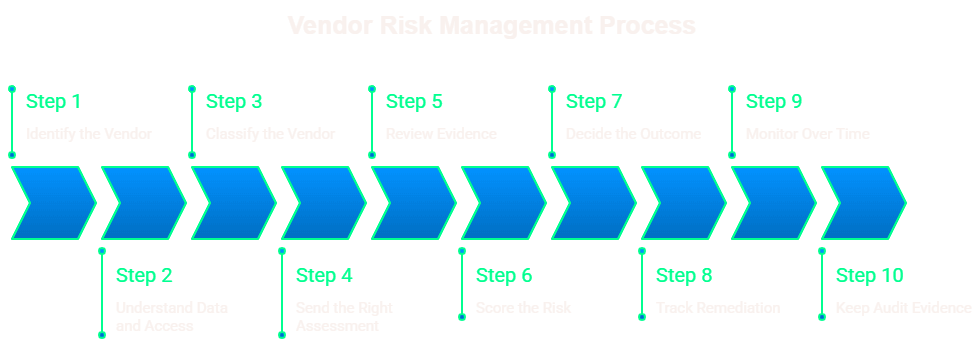
Step 1: Identify the Vendor
Record the vendor name, service type, business owner, contract owner, department, and purpose.
Step 2: Understand Data and Access
Document what data, systems, applications, networks, or users the vendor can access.
Step 3: Classify the Vendor
Assign a risk level based on data sensitivity, system access, business criticality, and dependency.
Step 4: Send the Right Assessment
Use a short assessment for low-risk vendors and a deeper questionnaire for high-risk vendors.
Step 5: Review Evidence
Ask for security policies, compliance reports, certifications, continuity plans, incident response procedures, or testing evidence where needed.
Step 6: Score the Risk
Rate the vendor as critical, high, medium, or low.
Step 7: Decide the Outcome
Approve, reject, conditionally approve, or request remediation.
Step 8: Track Remediation
Assign owners, deadlines, and evidence requirements for unresolved risks.
Step 9: Monitor Over Time
Review high-risk vendors regularly and reassess when the relationship changes.
Step 10: Keep Audit Evidence
Store assessments, approvals, evidence, contracts, exceptions, and remediation records.
What Are Vendor Risk Assessment Process Best Practices?
Best practices include using risk-based reviews, validating evidence, keeping templates simple, involving the right teams, tracking remediation, reviewing contracts, and reassessing vendors regularly.
Use these best practices:
- Segment vendors by risk level.
- Avoid using the same questionnaire for every vendor.
- Ask for evidence from high-risk vendors.
- Include procurement, legal, security, compliance, audit, and business owners.
- Track open risks with owners and due dates.
- Review contracts for data protection and breach notification terms.
- Reassess vendors after major changes.
- Keep evidence in one place.
- Train employees who request, approve, or manage vendors.
Common Mistakes to Avoid
- Treating vendor risk as only a procurement task
- Ignoring fourth-party or subcontractor risk
- Accepting incomplete questionnaire answers
- Not checking what data the vendor handles
- Not reviewing system access
- Not tracking remediation
- Forgetting to reassess vendors after changes
- Keeping evidence scattered across emails
Read more: What Is Meant by Risk Management?
What Are Third-Party Security Risk Assessment Templates?
A third-party security risk assessment template is a structured questionnaire or document used to collect vendor information, review controls, score risk, and document approval decisions.
A useful template should include:
- Vendor name and service description
- Business owner and contract owner
- Type of data handled
- System access level
- Security controls
- Privacy controls
- Compliance requirements
- Incident response process
- Business continuity process
- Subcontractor details
- Risk score
- Approval decision
- Remediation actions
- Review date
What If Vendor Answers Are Incomplete?
If a vendor gives incomplete answers, the business should not approve the relationship blindly. The team should request clarification, ask for evidence, assign conditional approval, add contract safeguards, or reject the vendor if the risk is unacceptable.
This section is useful because many vendor programs fail not because they lack forms, but because teams do not know what to do when responses are vague or unsupported.
Conclusion
Third-Party Risk Assessment helps organizations understand the risks created by vendors, suppliers, contractors, service providers, and business partners. Businesses should not trust vendors blindly. They should assess risk before onboarding, monitor important vendors over time, keep clear evidence, and train employees who manage vendor relationships.
Explore SecuRetain's learning platform and courses to build practical knowledge in cybersecurity, compliance, risk management, audit, business continuity, disaster recovery, fraud management, and employee awareness training.
You can also visit SecuRetain to explore how professionals and organizations can strengthen skills, improve awareness, and support continuous learning in a structured and scalable way.
FAQ's
A third-party risk assessment is a review of the risks created by vendors, suppliers, contractors, service providers, and business partners.
They are important because vendors may create security, privacy, compliance, operational, financial, and reputational risks for the organization.
It should be performed before onboarding, during renewals, after service changes, after incidents, and regularly for high-risk vendors.
It is a structured questionnaire or document used to collect vendor information, assess controls, score risk, and document approval decisions.
You reduce vendor risk by classifying vendors, reviewing controls, requesting evidence, fixing gaps, improving contracts, training employees, and monitoring high-risk vendors.
Build stronger vendor risk awareness
Explore SecuRetain courses and functional programs that help teams understand vendor risk, compliance, audit readiness, cybersecurity, and business resilience.
Related reads
Keep exploring
 Risk Management
Risk management is the structured process of identifying, assessing, controlling, and monitoring risks that may affect an organization's goals, operatio...
 Risk Management
Risk management frameworks and standards help organizations manage uncertainty through a structured process for identifying, assessing, treating, monito...
 Risk Management
The elements of risk management are the core parts that help organizations identify, assess, analyze, record, evaluate, treat, monitor, and report risks.