What Are the Key Elements of Risk Management? An Informational Guide

- Published:
- Last Updated:
The elements of risk management are the core parts that help organizations identify, assess, analyze, record, evaluate, treat, monitor, and report risks. These elements work together to create a structured process for managing uncertainty, improving decision-making, and building a stronger risk management culture.
Overview
Risk management is a continuous process made of connected elements that help organizations understand what can go wrong, how serious the impact may be, and what actions should be taken. Every organization faces risks from people, processes, technology, vendors, regulations, cybersecurity threats, financial changes, and operational failures. The elements of risk management help teams manage these risks in a consistent and practical way. Risk management elements work best when they are supported by a suitable framework, clear requirements, and strong governance. Marks, Larry. "The Optimal Risk Management Framework: Identifying the Requirements and Selecting the Framework." ISACA Journal 1 (2019). Published January 1, 2019.
In this guide, you will learn the key elements of risk management, including identification, assessment, analysis, treatment, monitoring, reporting, and how employee training connects them.
Key Findings
The elements of risk management help organizations bring clarity, structure, and accountability to how risks are identified, assessed, managed, and reviewed.
The most important points are:
- Risk management starts with identifying possible risks.
- Risk assessment and analysis help measure likelihood, impact, and severity.
- A risk register helps document risks, owners, controls, and status.
- Risk appetite and risk tolerance define how much risk is acceptable.
- Risk monitoring and reporting help organizations track changes and improve decisions.
- Employee training helps teams apply risk practices in daily work.
Recommendations
Organizations should treat risk management as an ongoing business process, not a one-time review. Risk changes as systems, vendors, regulations, threats, and business priorities change.
To strengthen the risk management process, organizations should define clear risk categories, assign risk owners, use consistent scoring methods, maintain an updated risk register, set risk appetite and tolerance levels, apply controls based on severity, monitor risks regularly, and train employees to recognize and report risks early.
What Are Key Elements of the Risk Management Process?
Risk Identification
Risk identification is the process of finding possible risks that may affect an organization's objectives, operations, systems, people, vendors, data, or compliance requirements. It is usually the first step because an organization cannot manage a risk that it has not identified. For example, weak passwords, outdated software, vendor dependency, poor access controls, or lack of employee awareness may all become risks if they are not detected early.
Risk Assessment
Risk assessment helps organizations measure how likely a risk is to happen and how much impact it may cause. It gives teams a clearer view of which risks need immediate attention and which can be monitored over time. A phishing risk, for example, may become high priority if employees are not trained, sensitive data is involved, and reporting procedures are weak. Risk assessment helps teams move from assumptions to practical decisions.
Risk Analysis
Risk analysis goes deeper than risk assessment. It helps organizations understand the causes, consequences, affected areas, and possible outcomes of a risk. While assessment measures the level of risk, analysis explains why the risk matters. For example, a social engineering risk may not only affect one employee; it may also lead to credential theft, data exposure, financial fraud, or compliance issues.
Risk Register
A risk register is a central record used to document and track risks. It usually includes the risk description, category, likelihood, impact, score, owner, existing controls, treatment plan, status, and review date. A risk register is important because it creates visibility and accountability. Without a risk register, risks may be discussed in meetings but forgotten later. It also supports audits, compliance reviews, leadership reporting, and continuous risk monitoring.
Risk Tolerance
Risk tolerance defines how much variation from an accepted risk level an organization can handle. It is more specific than risk appetite and is often applied to processes, systems, departments, or projects. For example, an organization may tolerate a short internal system delay but may not tolerate unauthorized access to customer data. Clear risk tolerance helps teams know when to escalate an issue, apply stronger controls, or stop an activity.
Risk Appetite
Risk appetite is the overall level of risk an organization is willing to accept while pursuing its business goals. It helps leadership define whether the organization should be cautious, balanced, or aggressive in certain decisions. A startup may accept more innovation risk, while a financial or healthcare organization may accept very little compliance, privacy, or security risk. Risk appetite gives direction to managers and helps align risk decisions with business strategy.
Risk Evaluation
Risk evaluation compares the assessed risk level with business priorities, risk appetite, risk tolerance, and control effectiveness. It helps organizations decide whether a risk is acceptable, needs treatment, requires escalation, or should be approved by leadership. This element prevents teams from overreacting to low-level risks and underreacting to serious risks. Risk evaluation makes the process more practical and business-focused.
Risk Treatment / Mitigation
Risk treatment, also called risk mitigation, is the action taken after a risk is evaluated. Organizations may avoid the risk by stopping the activity, reduce the risk by applying controls, transfer part of the risk through insurance or contracts, or accept the risk with proper approval and documentation. For example, if employees are exposed to phishing risk, the organization may reduce it through awareness training, email security, reporting procedures, and regular simulations.
Risk Monitoring
Risk monitoring is the ongoing process of tracking risks, controls, incidents, and business changes. Risks do not stay the same. A low risk today can become high risk after a new vendor is added, a regulation changes, a system is updated, or a cyber threat increases. Monitoring helps organizations review open risks, update scores, check control performance, track overdue actions, and respond before risks become serious incidents. Cyber risks change quickly, so continuous monitoring, updated controls, and proactive response planning are important for modern risk management. Forbes Technology Council. "2026 Cyber Risk Management Strategies To Adopt Now." Forbes, March 2, 2026.
Risk Reporting and Review
Risk reporting and review help communicate risk information to the right people at the right time. Reports may be shared with managers, compliance teams, auditors, cybersecurity teams, and business leaders. Good reporting explains top risks, changing risk levels, open actions, control gaps, incident trends, and owner updates. Regular review ensures that risk information remains accurate, useful, and aligned with business decisions.
How Does Employee Training Connect All Elements of Risk Management?
Employee training connects all elements of risk management because people are involved in identifying, reporting, controlling, and monitoring risks. The human element is important because employees directly affect risk identification, reporting, control performance, and daily security behavior. Danen, Vincent. "The Human Element of Risk Management." Forbes, February 6, 2025.
Training helps employees:
- Recognize risks in daily work
- Follow policies and controls
- Report incidents early
- Understand compliance expectations
- Protect data and systems
- Support audit readiness
- Reduce human error
Conclusion
The elements of risk management help organizations manage uncertainty in a structured and practical way. A strong risk management process depends on clear ownership, regular review, practical controls, and employee training.
Explore SecuRetain's learning platform and courses to build practical knowledge in cybersecurity, compliance, risk management, audit, business continuity, disaster recovery, fraud management, and employee awareness training.
You can also visit SecuRetain to explore how professionals and organizations can strengthen skills, improve awareness, and support continuous learning in a structured and scalable way.
FAQ's
The main elements of risk management include risk identification, assessment, analysis, register, tolerance, appetite, evaluation, treatment, monitoring, and reporting.
Risk management elements are important because they help organizations identify risks, prioritize actions, apply controls, and monitor risk status consistently.
Risk identification is usually the first element because organizations must first understand what risks exist before they can assess or manage them.
Risk appetite is the overall level of risk an organization is willing to accept, while risk tolerance is the specific limit or variation allowed for a risk.
Training helps employees recognize risks, follow controls, report issues early, and support compliance, cybersecurity, and audit preparation.
Build practical risk management capability
Explore SecuRetain courses and functional programs that help teams understand risk, compliance, audit readiness, cybersecurity, and business resilience.
Related reads
Keep exploring
 DPDP
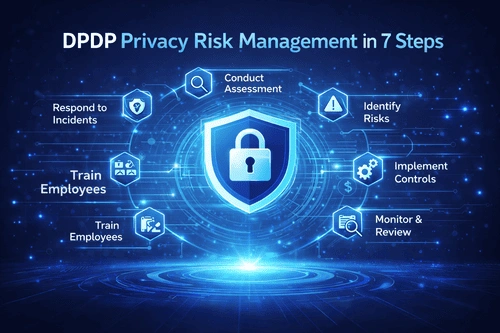
DPDPMaster privacy risk management under India's DPDP Act with this practical 7-step approach. Implement assessments, controls, monitoring, and remediation for Data Fiduciaries to...
 Risk Management
Risk management is the structured process of identifying, assessing, controlling, and monitoring risks that may affect an organization's goals, operatio...
 Risk Management
Risk management frameworks and standards help organizations manage uncertainty through a structured process for identifying, assessing, treating, monito...