What Is AI Risk Management? A Simple Guide for Businesses 2026

- Published:
- Last Updated:
AI risk management is the process of identifying, assessing, reducing, monitoring, and governing risks that come from using artificial intelligence systems. It helps organizations use AI safely, fairly, securely, and responsibly while reducing business, compliance, security, privacy, and operational risks.
Overview
AI is now used in customer support, fraud detection, hiring, cybersecurity, finance, marketing, analytics, automation, and decision-making. While AI can improve speed and efficiency, it can also create new risks if systems are poorly designed, trained, deployed, or monitored.
AI risk management helps organizations understand where AI may create harm, errors, bias, data exposure, security weaknesses, or compliance issues. For a 2026 view on how AI risk is becoming more important as AI moves into real business production, this source is useful: Wickramasinghe, Shanika, and Shaun Quarton. "AI Risk Management in 2026: AI Moves into Production." Splunk, January 28, 2026. The NIST AI Risk Management Framework describes AI risk management as a way to improve trustworthiness in the design, development, use, and evaluation of AI systems.
Key Findings
- AI risk management helps identify and reduce risks in AI systems.
- Common AI risks include bias, privacy issues, cyber threats, legal exposure, and lack of transparency.
- AI can support fraud detection, threat prediction, control monitoring, and better decisions.
- AI governance defines policies, ownership, documentation, and monitoring.
- AI risk management should continue across the full AI lifecycle.
What is AI risk management?
AI risk management means identifying and controlling risks that arise when AI is developed, deployed, or used in business processes. These risks may include biased outputs, poor data quality, weak security, unclear decisions, misuse, or lack of human review.
The goal is to make AI safer, more reliable, and accountable without stopping adoption. For example, if AI is used in loan approval, recruitment, fraud detection, or cybersecurity alerts, organizations must understand how it works, what errors may occur, and who is responsible.
Read more: What Are the 5 P's of Risk Management?
What is the Role of AI in Risk Management?
AI plays two roles in risk management. First, AI creates risks that must be controlled. Second, AI can help risk teams identify and manage risks faster.
AI can support risk management by:
- Detecting unusual transactions or fraud patterns
- Monitoring cybersecurity threats
- Reviewing large volumes of audit or compliance data
- Predicting operational failures
- Prioritizing vulnerabilities or incidents
- Supporting third-party risk monitoring
- Identifying policy violations or control gaps
Why Does Risk Management in AI Systems Matter?
AI systems can affect customers, employees, operations, and business decisions.
Clear controls help reduce these risks.
- Helps reduce inaccurate or biased decisions
- Prevents financial loss and reputational damage
- Reduces customer harm and operational disruption
- Supports compliance and responsible AI use
- Improves transparency, accountability, and human oversight
- Helps detect issues before they become serious risks
For example, weak AI controls may cause a chatbot to give wrong answers, a hiring tool to reject suitable candidates, or a fraud model to block genuine users.
What Are the Key Types of AI Risks?
AI risks can affect different parts of the business. The most common types include:
| AI Risk Type | What It Means | Business Impact |
|---|---|---|
| Data risk | Poor, incomplete, or sensitive data is used | Wrong outputs or privacy exposure |
| Bias risk | AI treats groups unfairly | Legal, ethical, and reputation issues |
| Security risk | AI systems are attacked or misused | Data breach or system compromise |
| Accuracy risk | AI gives wrong or misleading results | Bad decisions and customer impact |
| Compliance risk | AI use violates laws or policies | Fines, audit gaps, or legal exposure |
| Transparency risk | Users cannot understand AI decisions | Low trust and weak accountability |
| Operational risk | AI fails or works unpredictably | Business disruption |
- Data risk: Wrong data can lead to wrong outputs.
- Bias risk: Unfair results can harm trust and reputation.
- Security risk: Attacks can cause breaches or misuse.
- Accuracy risk: Incorrect results can affect decisions.
- Compliance risk: Policy or legal gaps can create penalties.
- Transparency risk: Unclear decisions reduce accountability.
- Operational risk: AI failure can disrupt business.
What Are Examples of AI in Risk Management?
AI in risk management is already used across many business functions. Examples include fraud detection in banking, suspicious login monitoring in cybersecurity, risk scoring in third-party management, anomaly detection in operations, and compliance monitoring in regulated industries.
In cybersecurity, AI can help detect unusual behavior, phishing patterns, malware indicators, or abnormal access attempts. In audit and compliance, AI can help review large documents, identify missing evidence, or flag control weaknesses.
In financial services, AI can support credit risk, transaction monitoring, and fraud alerts. In business continuity, AI can help predict disruptions and support faster incident response. The value comes from combining AI automation with human review and clear governance.
Read more: 8 Essential Risk Management Frameworks
What Are the Best Practices for Implementing AI in Risk Management?
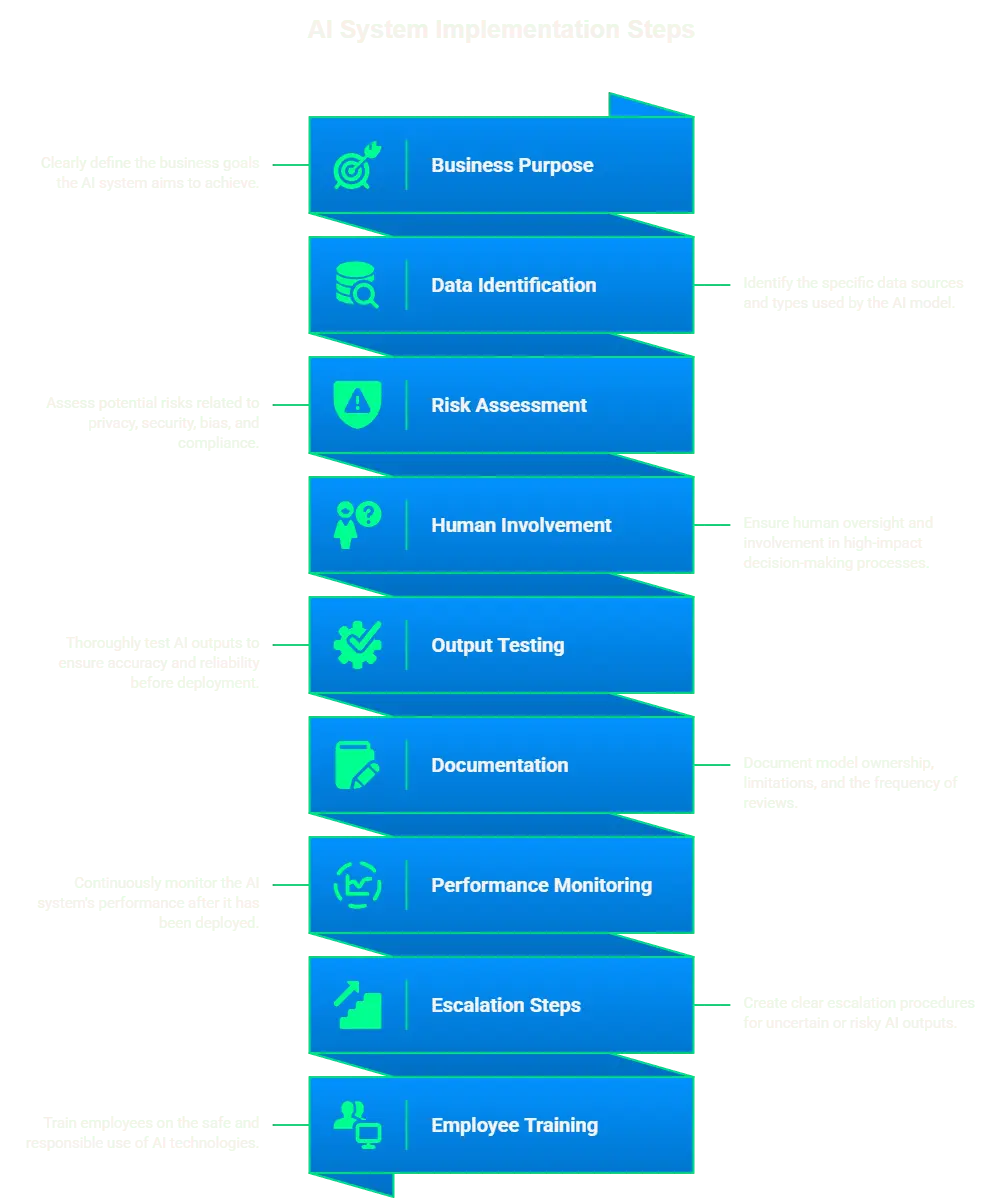
Organizations should implement AI carefully instead of using it without controls.Shadow AI and agentic AI risks also show why businesses need stronger visibility, ownership, and monitoring: Tymoshyk, Nazar. "AI Risk Management 2026: Shadow AI, Agentic Risks & NIST Implementation Playbook." UnderDefense, April 25, 2026.
Best practices include:
- Define the business purpose of the AI system.
- Identify the data used by the AI model.
- Assess privacy, security, bias, and compliance risks.
- Keep humans involved in high-impact decisions.
- Test AI outputs before deployment.
- Document model ownership, limits, and review frequency.
- Monitor performance after deployment.
- Create escalation steps when AI gives uncertain or risky outputs.
- Train employees on safe and responsible AI use.
What Is the Difference Between AI Risk Management and AI Governance?
AI risk management focuses on identifying, assessing, and reducing risks that may arise from AI systems. It looks at what can go wrong, such as biased outputs, inaccurate results, privacy issues, cybersecurity risks, misuse, or lack of human review. The purpose is to control these risks before they affect business decisions, customers, compliance, or operations.
AI trust, risk, and security management also connects governance with safer AI adoption: (Boettcher, Timothy. "AI TRiSM Framework: Complete Guide to Trust, Risk, and Security in AI." AvePoint, September 1, 2025. Accessed July 3, 2026.) AI governance focuses on how AI is controlled, approved, monitored, and documented within the organization. It defines who owns the AI system, who approves its use, what policies apply, how performance is reviewed, and what evidence is maintained to show responsible AI usage.
Understanding the risks associated with AI systems
AI systems can create risk at every stage of their lifecycle. Organizations should ask practical questions such as:
- What decision does the AI system support?
- What data does it use?
- Who can access the AI system?
- Can the output be explained?
- What happens if the AI gives a wrong answer?
- Is human review required?
- How often is the model tested?
- What evidence is kept for audit and compliance?
Read more: What Is Meant by Risk Management?
What Is the Role of Tools and Technologies in AI Risk Management?
Tools and technologies help organizations manage AI risks more consistently.
Common tool categories include:
- AI governance platforms
- Model monitoring tools
- Data quality tools
- Security testing tools
- Privacy management tools
- GRC platforms
- Vendor risk management tools
- Audit and evidence management systems
Conclusion
AI risk management helps organizations use artificial intelligence responsibly while reducing risks related to bias, privacy, security, compliance, accuracy, and accountability. It supports safer AI adoption by combining risk assessment, governance, monitoring, documentation, and employee awareness.
Explore SecuRetain's learning platform and courses to build practical knowledge in cybersecurity, compliance, risk management, audit, business continuity, disaster recovery, fraud management, and employee awareness training.
You can also visit SecuRetain to explore how professionals and organizations can strengthen skills, improve awareness, and support continuous learning in a structured and scalable way.
FAQ's
AI risk management is the process of identifying, assessing, reducing, and monitoring risks linked to artificial intelligence systems.
It is important because AI systems can affect business decisions, customer trust, privacy, security, compliance, and operational performance.
The main AI risks include bias, privacy exposure, inaccurate outputs, security threats, compliance gaps, lack of transparency, and operational failure.
AI helps risk management by detecting patterns, identifying anomalies, predicting threats, reviewing large data sets, and supporting faster decision-making.
Businesses can start by creating an AI inventory, classifying AI use cases by risk, assigning owners, testing outputs, documenting controls, and monitoring performance.
Build practical AI risk management capability
Explore SecuRetain courses and functional programs that help teams understand AI risk, governance, compliance, cybersecurity, audit readiness, and responsible technology use.
Related reads
Keep exploring
 Risk Management
Risk management is the structured process of identifying, assessing, controlling, and monitoring risks that may affect an organization's goals, operatio...
 Risk Management
Risk management frameworks and standards help organizations manage uncertainty through a structured process for identifying, assessing, treating, monito...
 Risk Management
The elements of risk management are the core parts that help organizations identify, assess, analyze, record, evaluate, treat, monitor, and report risks.