What Is the Classification of Risk Management? Types, Examples, and Training Guide

- Published:
- Last Updated:
Risk classification is the process of grouping risks into clear categories so organizations can identify, prioritize, assign ownership, and control them better. This guide highlights the meaning of risk classification, major risk types, simple examples, and how training helps employees understand, report, and manage risks more effectively across business functions.
Overview
Risk classification helps organizations arrange different risks into simple, manageable groups. Instead of treating every risk as separate or confusing, teams can classify risks by type, impact, likelihood, function, owner, or control status. This makes it easier to understand where risks come from, how serious they are, who should manage them, and what action is needed.
Key Findings
- Risk classification makes risk management clearer.
- Common risk types include strategic, operational, financial, compliance, cyber, reputational, third-party, and project risks.
- Grouping risks helps assign owners, reduce duplication, and plan controls.
- Project risks affect one initiative; business risks affect the organization.
- Strategic risks affect long-term direction; operational risks affect daily work.
What is Risk Classification?
Risk classification means grouping risks into categories based on their nature, source, impact, or business function. Risk classification helps teams answer simple but important questions: What type of risk is this? Which team owns it? How serious is the impact? What control is needed? How should it be reported?. Javier Perez and Rick Vanover, in "Risk Management Framework: How Veeam Strengthens Cyber Resilience," Veeam Blog, October 17, 2025, updated June 17, 2026, explain that a risk management framework gives organizations a structured method to identify, assess, reduce, and monitor risks across people, processes, and technology.
For example, a data breach may be classified as a cybersecurity risk, while poor cash flow may be classified as a financial risk. This makes risk review simpler and more organized.
Risk classification helps teams answer:
- What type of risk is this?
- Which team owns it?
- How serious is the impact?
- What control is needed?
- How should it be reported?
Why is risk classification important?
Risk classification is important because it helps organizations understand risks in a structured and meaningful way. When risks are grouped properly, teams can see which areas are more exposed, which issues may affect business goals, and which risks need faster attention.
It also reduces confusion because similar risks are placed under the right categories instead of being repeated across different departments. Clear classification supports better ownership, stronger reporting, practical control planning, and quicker decision-making. It also helps employees understand their role in managing risk and makes audit or compliance reviews easier to handle.
Read more: What Are the 5 P's of Risk Management?
What Are the Major Categories of Business Risk?
Business risks can be grouped into different categories based on how they affect the organization.
Common categories include:
- Strategic Risk: Risk linked to business goals, competition, market changes, or poor planning.
- Operational Risk: Risk from failed processes, people, systems, or daily operations.
- Financial Risk: Risk linked to cash flow, credit, investment, fraud, or financial loss.
- Compliance Risk: Risk from failing to follow laws, regulations, policies, or standards.
- Cybersecurity Risk: Risk from data breaches, malware, phishing, weak access, or system attacks.
- Reputational Risk: Risk that damages customer trust, brand image, or public confidence.
- Third-Party Risk: Risk from vendors, suppliers, contractors, or service providers.
- Project Risk: Risk that affects project cost, quality, timeline, or delivery.
Vikas Sharma, in "Discover the ISO 31000 Risk Categories That Will Transform Your Risk Strategy," NovelVista, last updated November 25, 2025, notes that ISO 31000 does not force one fixed list of risk categories; instead, it gives organizations a flexible structure they can adapt to their own environment.
Why Should Organizations Group Risks Into Categories?
Grouping risks into clear categories helps organizations understand where problems may come from, who should manage them, and which controls are needed first.
Risk categories help teams:
- Find similar risks quickly
- Avoid duplicate reporting
- Assign the right risk owner
- Compare risk levels
- Plan better controls
- Track trends across departments
- Report risks to leadership clearly
What Are Common Risk Classification Systems?
Risk classification systems help organizations arrange risks in a consistent format.
Common systems include:
- By Risk Type: Strategic, operational, financial, cyber, compliance, or reputational.
- By Impact Level: Critical, high, medium, or low.
- By Likelihood: Rare, possible, likely, or almost certain.
- By Business Function: HR, finance, IT, legal, sales, operations, or procurement.
- By Control Status: Controlled, partially controlled, or uncontrolled.
- By Timeframe: Short-term, medium-term, or long-term risk.
How Are Project Risks Different from Business Risks?
Project risks affect a specific project, while business risks affect the wider organization.
Here's a simple comparison:
| Basis | Project Risks | Business Risks |
|---|---|---|
| Meaning | Linked to one project | Linked to the whole organization |
| Impact | Timeline, cost, scope, or quality | Strategy, finance, compliance, or reputation |
| Examples | Delays, budget overrun, vendor issues | Cyber incidents, penalties, market changes |
| Owner | Project manager or team | Management, risk, or compliance teams |
| Timeframe | Usually short-term | Short-term or long-term |
| Focus | Successful project delivery | Business stability and growth |
Project Risks
- Affect one specific project or activity
- Linked to deadlines, budget, scope, resources, vendors, and quality
- Usually short-term
- Managed by the project manager or project team
Business Risks
- Affect the overall organization
- Linked to compliance, cybersecurity, finance, operations, market changes, and reputation
- Can affect long-term growth and stability
- Managed by leadership, risk teams, or department heads
Read more: 8 Essential Risk Management Frameworks
How Can Employees Help Control Different Risk Areas?
Employees play an important role in identifying and reducing risks.
They can help by:
- Reporting suspicious emails
- Following security policies
- Protecting customer data
- Using approved tools
- Escalating process failures
- Completing risk training
- Following compliance requirements
- Reporting vendor or operational issues
How to Identify and Define Risk Categories for Your Organisation?
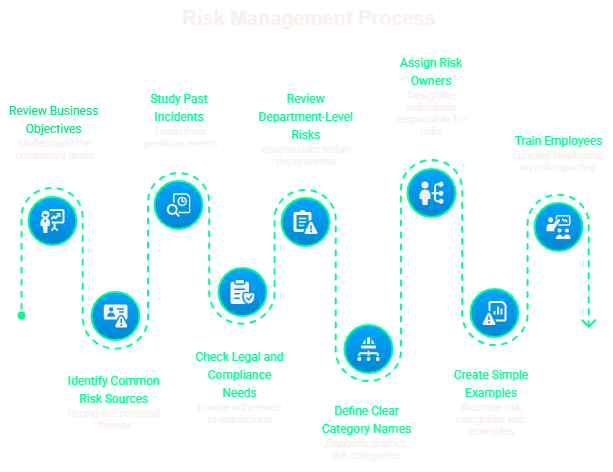
Organizations should define risk categories based on their industry, services, operations, compliance needs, and business goals.
Useful steps include:
- Review business objectives
- Identify common risk sources
- Study past incidents
- Check legal and compliance needs
- Review department-level risks
- Define clear category names
- Assign risk owners
- Create simple examples for each category
- Train employees on how to report risks
Read more: What Is Meant by Risk Management?
How Are Strategic and Operational Risks Different?
Strategic risks affect long-term business goals, while operational risks affect daily business activities.
Strategic Risks
- Affect long-term business goals and direction
- Linked to market decisions, expansion, competition, product strategy, and customer demand
- Usually managed by leadership and senior management
- Can impact growth, revenue, brand position, and future planning
Operational Risks
- Affect daily business activities and internal processes
- Linked to system downtime, human error, process failure, supply chain issues, and weak controls
- Usually managed by department heads, operations teams, and control owners
- Can impact productivity, service quality, customer experience, and business continuity
Read more: What Is a Third-Party Risk Assessment?
How Can SecuRetain Support Risk Learning Across Teams?
SecuRetain helps organizations build risk awareness through eLearning, certification courses, and corporate training programs.
It can support risk learning by helping teams:
- Understand risk classification basics
- Learn different types of business risks
- Improve risk identification skills
- Understand cybersecurity and compliance risks
- Build stronger audit and governance knowledge
- Train employees across departments
- Track course progress and completion
- Customize learning based on internal risk needs
This helps organizations create a stronger risk-aware culture.
Conclusion
Risk classification gives organizations a clear way to understand and manage different risk areas. It helps teams identify what type of risk exists, who should manage it, and what controls are needed.
Explore SecuRetain's learning platform and courses to build practical knowledge in cybersecurity, compliance, risk management, audit, business continuity, disaster recovery, fraud management, and employee awareness training.
You can also visit SecuRetain to explore how professionals and organizations can strengthen skills, improve awareness, and support continuous learning in a structured and scalable way.
FAQ's
Risk classification is the process of grouping risks into clear categories based on their source, impact, likelihood, or business area.
The main types include strategic, operational, financial, compliance, cybersecurity, reputational, third-party, and project risks.
Risk classification is important because it helps organizations prioritize risks, assign owners, plan controls, and improve reporting.
A phishing attack can be classified as a cybersecurity risk, while delayed project delivery can be classified as a project risk.
Employees support risk classification by reporting issues, following controls, completing training, and identifying risks in daily work.
Build practical risk management capability
Explore SecuRetain courses and functional programs that help teams understand risk, compliance, audit readiness, cybersecurity, and business resilience.
Related reads
Keep exploring
 Risk Management
Risk management is the structured process of identifying, assessing, controlling, and monitoring risks that may affect an organization's goals, operatio...
 Risk Management
Risk management frameworks and standards help organizations manage uncertainty through a structured process for identifying, assessing, treating, monito...
 Risk Management
The 5 P's of risk management are People, Process, Principles, Perception, and Practice. They help organizations understand risk in a simple way.