Ethical Hacking Course for Beginners: Learn Safe Security Testing

- Published:
- Last Updated:
An ethical hacking course for beginners teaches the foundations of networking, systems, web security, authorised testing, tools, reporting, and remediation. This guide explains what to learn, how to practise safely, common mistakes to avoid, and how to build practical, job-ready cybersecurity skills.
Overview
An ethical hacking course for beginners teaches learners how to identify security weaknesses legally, assess their possible impact, document findings, and recommend appropriate fixes. It combines technical concepts, practical exercises, ethical boundaries, and professional reporting.
Testing should take place only in personal laboratories, authorised training environments, or systems covered by written permission. Ethical hacking is intended to strengthen security, not access systems without approval.
Key Findings
The best beginner courses teach technical fundamentals before advanced tools and combine theory with safe, practical exercises. Learners also need reporting, communication, remediation, and business-risk skills.
Important findings include:
- Networking and operating-system knowledge should come first.
- Practical laboratories build confidence and technical ability.
- Written permission is required before testing real systems.
- Tools should support understanding, not replace it.
- Findings should explain technical and business impact.
- Remediation should be verified through retesting.
- Certifications should be supported by practical projects.
Career-focused training should also connect practical knowledge with recognised learning pathways, as explained in Wintemute, Doug. “Cybersecurity Certifications for Beginners: Everything You Need to Know.” Forbes Advisor, April 21, 2026. Learners also need reporting, communication, remediation, and business-risk skills.
What Is an Ethical Hacking Course for Beginners?
An ethical hacking course for beginners teaches learners to identify, assess, document, and help resolve security weaknesses with permission. It combines technical foundations, controlled exercises, ethics, and reporting.
A complete course should cover:
- Networking and operating systems
- Web applications and authentication
- Common security weaknesses
- Authorised testing methods
- Reporting, remediation, and retesting
Which Key Terms Should Beginners Know?
- Authorisation: Written permission to test.
- Scope: Approved targets, methods, and limits.
- Vulnerability: A weakness that creates risk.
- Penetration testing: An authorised security assessment.
- Remediation: Action taken to correct a weakness.
Read also: What is Ethical Hacking? A Beginner's Guide to Cybersecurity
What Should an Ethical Hacking Course Teach Before Introducing Tools?
A course should first teach networking, operating systems, web technologies, access control, and basic scripting. These foundations help learners understand tool output, recognise false positives, and explain why a weakness matters.
To build a strong cybersecurity foundation, focus on these five key areas:
| Learning area | What to study | Practical outcome |
|---|---|---|
| Networking | IP, DNS, ports, and protocols | Understand communication |
| Systems | Users, files, and permissions | Navigate Windows and Linux |
| Web security | HTTP, sessions, and authentication | Recognise control weaknesses |
| Scripting | Basic Python or Bash | Automate simple tasks |
| Reporting | Evidence, impact, and remediation | Produce useful findings |
- Networking: Understand system communication.
- Systems: Manage files and permissions.
- Web Security: Identify web vulnerabilities.
- Scripting: Automate basic tasks.
- Reporting: Document findings clearly.
How Does the Ethical Hacking Process Work?
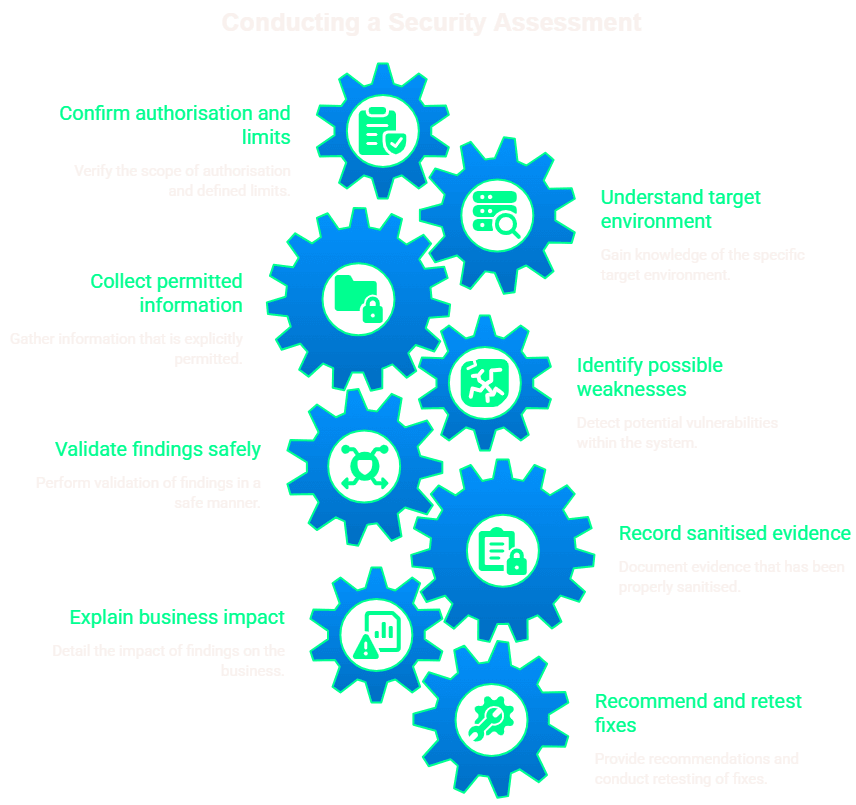
Ethical hacking follows a controlled process that begins with permission and ends with remediation and retesting. Every activity must remain within the approved scope.
A responsible process includes:
- 1.Confirm authorisation and limits.
- 2.Understand the target environment.
- 3.Collect permitted information.
- 4.Identify possible weaknesses.
- 5.Validate findings safely.
- 6.Record sanitised evidence.
- 7.Explain business impact.
- 8.Recommend and retest fixes.
How Can Beginners Practise Ethical Hacking Safely and Legally?
Beginners should practise only in personal labs, intentionally vulnerable applications, authorised platforms, or systems covered by written permission. Testing public or workplace systems without approval may create legal, privacy, and operational risks.
Follow these rules:
- Confirm scope before each exercise.
- Keep real data out of labs.
- Stop if testing could disrupt services.
- Verify commands before running them.
- Protect evidence and report privately.
- Retest only while permission remains valid.
Common mistakes include copying commands blindly, trusting scanner output without validation, collecting unnecessary data, and sharing findings publicly. Structured learning platforms can provide safer environments for developing practical skills, as discussed in Vaishnavi. “Best Websites to Learn Cybersecurity Online: Top Platforms for Beginners and Professionals to Build a Strong Career in Cybersecurity.” WebAsha Technologies, February 13, 2025. Testing public or workplace systems without approval may create legal, privacy, and operational risks.
Read more: How Ethical Hacking Certifications Help Build a Strong Cybersecurity Career
How Can an Ethical Hacking Course Help You Build a Job-Ready Portfolio?
A strong ethical hacking course for beginners should help learners create evidence of responsible practical work, not only collect certificates.
Each project should include:
- Objective and authorised scope
- Simple laboratory diagram
- Testing method and sanitised evidence
- Technical risk and business impact
- Recommended remediation
- Retest result and lessons learned
How can beginners practice ethical hacking safely and legally?
Beginners should practice only in approved labs, training platforms, personal test environments, or systems where they have clear permission. Practicing without authorization can create serious consequences.
Safe practice methods include:
- Using cybersecurity labs designed for beginners.
- Creating a personal test environment on your own computer.
- Practicing on intentionally vulnerable applications.
- Joining approved training challenges.
- Reading vulnerability reports to understand real examples.
- Avoid public systems unless written permission is given.
What Should Beginners Avoid?
Beginners should avoid testing anything they do not own or do not have permission to assess. Curiosity should never cross legal or ethical boundaries.
Avoid:
- Scanning public websites without approval.
- Testing company systems without written permission.
- Trying password attacks on real accounts.
- Sharing sensitive findings publicly.
- Using tools without understanding their impact.
- Ignoring scope, rules, or safety limits.
Read more: How Ethical Hacking Helps Identify Credential Theft Risks
How Should You Begin Your Ethical Hacking Learning Journey?
Begin with an ethical hacking course for beginners that covers networking, system security, authorised testing, vulnerability assessment, reporting, and remediation. Choose structured training that combines clear concepts, practical exercises, assessments, and real-world risk scenarios.
Cybersecurity certification courses can help strengthen technical knowledge, responsible testing practices, and career-ready skills. The right programme should develop practical capability not just familiarity with tools.
Conclusion
An ethical hacking course for beginners should develop technical foundations, responsible testing habits, practical reporting skills, and an understanding of business risk. Choose structured training that combines theory, controlled exercises, assessments, remediation, and portfolio development.
Explore SecuRetain’s learning platform and our all courses to build practical knowledge in cybersecurity, compliance, risk management, audit, business continuity, disaster recovery, fraud management, and employee awareness training.
You can also visit our website to explore how SecuRetain helps professionals and organizations strengthen skills, improve awareness, and support continuous learning in a structured and scalable way.
FAQ's
Yes. A beginner course should introduce networking, operating systems, web security, authorised testing, reporting, and remediation without requiring advanced cybersecurity knowledge.
Yes. You can begin with networking, Linux, Windows, and web-security fundamentals. Basic Python or Bash can be learned later for automation.
Relevant entry-level roles may include security analyst, vulnerability assessment analyst, penetration-testing trainee, SOC analyst, and cybersecurity support specialist.
Useful projects include assessing a vulnerable web application, documenting access-control issues, analysing network traffic, preparing a vulnerability report, and verifying remediation.
Only basic coding is needed at first. Scripting becomes more useful later for automation, data analysis, and understanding application behaviour.
Build practical cybersecurity skills
Explore SecuRetain courses that combine cybersecurity concepts, safe practical exercises, assessments, and real-world risk scenarios.
Related reads
Keep exploring
 Ethical Hacking
Ethical hacking is the authorized practice of testing systems, networks, applications, and security processes to find weaknesses before attackers exploit them.
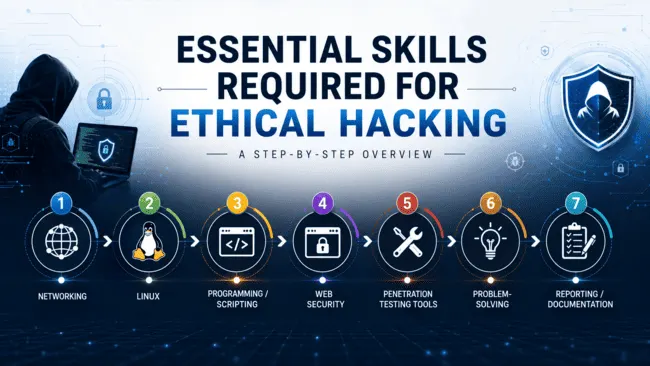 Ethical Hacking
Skills required for ethical hacking include networking, operating systems, web security, scripting, security tools, reporting, and legal awareness.
 Ethical Hacking
Basic penetration testing is an authorized security assessment that helps identify, validate, and report security weaknesses before attackers can misuse them.