Ethical Hacking Techniques: A Complete Beginner-Friendly Guide

- Published:
- Last Updated:
The strongest cybersecurity defenses are built by understanding how attackers think before they act. Ethical hacking techniques help security professionals identify weak points in systems, networks, applications, and human behavior before real attackers can exploit them. In this guide, one will learn which ethical hacking techniques matter most, how they are used in real security testing, and why they are important for building stronger cybersecurity skills.
What is Ethical Hacking Techniques
Ethical hacking techniques are authorized security testing methods used to find weaknesses in systems, networks, applications, and human behavior before attackers can exploit them. These techniques include reconnaissance, scanning, vulnerability testing, password security testing, social engineering testing, SQL injection testing, cross-site scripting testing, and traffic analysis.
The main purpose is to understand security risks, test existing defenses, and provide clear recommendations to improve cybersecurity. Ethical hacking must always be performed with proper permission, a defined scope, and legal approval.
Why Ethical Hacking Techniques Matter Today
Ethical hacking techniques are authorized security testing methods used to identify, verify, and report weaknesses in systems, networks, applications, and human security processes. Their purpose is not to damage systems but to improve protection.
Key techniques include:
- Reconnaissance: Collecting basic information about systems, domains, technologies, and public exposure.
- Scanning: Checking networks, ports, services, and applications for possible entry points.
- Vulnerability assessment: Finding known security gaps, outdated software, and misconfigurations.
- Penetration testing: Safely validating whether a weakness can create business risk.
- Web application testing: Reviewing login, input fields, APIs, sessions, and access controls.
- Reporting: Explaining risks, evidence, impact, and remediation steps clearly.
Why Do Ethical Hackers Use These Techniques?
Ethical hackers use these methods to think like attackers while acting like trusted security professionals. The goal is to discover security gaps early and help organizations fix them before real incidents happen.
Ethical hacking techniques help organizations:
- Identify weak passwords, exposed services, and insecure configurations.
- Detects application flaws such as injection, broken authentication, and access control issues.
- Test whether security tools and monitoring systems can detect suspicious activity.
- Improve incident response by showing how an attack path may look.
- Support compliance, audit readiness, and risk management.
- Prioritize fixes based on real business impact instead of only technical severity.
Reconnaissance and Information Gathering Techniques in Ethical Hacking
Reconnaissance is the first stage of ethical hacking, where testers collect information about systems, domains, technologies, and public exposure. This helps understand the attack surface before deeper testing begins.
Common reconnaissance methods include:
- Passive reconnaissance: Collecting publicly available information without directly interacting with the target system.
- Active reconnaissance: Gathering information by interacting with approved systems within the testing scope.
- WHOIS lookup: Reviewing domain registration details, ownership records, and related metadata.
- DNS lookup: Checking domain records, subdomains, mail servers, and name servers.
- Technology stack identification: Understanding which frameworks, servers, CMS platforms, or application technologies are being used.
- Public exposure review: Identifying exposed assets, outdated pages, leaked documents, or unnecessary public information.
Read also: Ethical Hacking Roadmap Step by Step: Key Skills and Specializations
Scanning Techniques in Ethical Hacking?
Scanning techniques in ethical hacking help identify active systems, open ports, running services, network paths, and exposed assets. Ethical hackers use scanning to understand where security risks may exist, but scanning must always be done carefully within an approved scope to avoid disruption.
| Scanning Technique | What It Checks | Why It Matters |
|---|---|---|
| Port scanning | Open ports and running services | Finds exposed entry points |
| Enumeration | System, service, and user-related details | Helps understand possible weaknesses |
| Network mapping | Connected systems and communication paths | Shows how assets are structured |
| Service detection | Software and service versions | Helps find outdated components |
| Firewall review | Filtering and access behavior | Shows whether controls are effective |
Vulnerability Testing Techniques in Ethical Hacking
Vulnerability testing identifies weaknesses that could expose systems, data, or users to cyber risk. It includes automated checks, manual validation, and business-risk analysis.
Common vulnerability testing areas include:
- Vulnerability scanning: Finding known flaws in systems, applications, and services.
- Misconfiguration testing: Checking insecure settings, default configurations, and weak access rules.
- Weak authentication testing: Reviewing password policies, login protections, MFA, and account lockout settings.
- Input validation testing: Checking whether applications properly handle user input.
- Patch review: Identifying outdated software, missing updates, and unsupported components.
- Access control testing: Verifying whether users can access only what they are allowed to access.
Read also: How to Start Ethical Hacking for Beginners
Exploitation Techniques in Ethical Hacking
Exploitation in ethical hacking means safely validating whether a weakness can create real security risk. It must be controlled, documented, and performed only within approved limits.
Common controlled exploitation areas include:
- Social engineering testing: Measuring whether employees can identify phishing, impersonation, or manipulation attempts.
- Password security testing: Reviewing weak, reused, or easily guessable passwords through authorized audits.
- SQL injection testing: Checking whether applications safely handle database-related input.
- Cross-site scripting testing: Reviewing whether user input can affect browser-side behavior.
- Network sniffing and traffic analysis: Checking whether sensitive data is exposed in network communication.
- Privilege testing: Verifying whether users can gain access beyond their approved role.
How Master Ethical Hacking Techniques
Mastering ethical hacking techniques requires consistent learning, legal practice, and a strong understanding of cybersecurity fundamentals. Beginners should not jump directly into advanced testing. They should first build a clear base in networking, operating systems, web security, and vulnerability analysis.
To master ethical hacking techniques:
- Learn basic networking concepts such as IP addresses, DNS, ports, protocols, and firewalls.
- Understand Linux, Windows, command-line usage, files, permissions, and system logs.
- Study common vulnerabilities such as weak authentication, SQL injection, XSS, and misconfigurations.
- Practice only in legal labs, sandbox environments, and authorized testing platforms.
- Learn how to use security tools, but do not depend only on automated results.
- Build reporting skills to explain findings, risk impact, and remediation steps clearly.
Conclusion
Ethical hacking techniques are important because they help organizations discover risks before attackers can exploit them. From reconnaissance and scanning to vulnerability testing, social engineering, password testing, SQL injection testing, XSS testing, and traffic analysis, each technique plays a role in building stronger cybersecurity.
To take your learning to the next level, explore our diverse selection of courses designed to help you grow professionally. Visit our Courses page to find the perfect course for your needs.
Start your journey today with SecuRetain, where we support your path to success.
FAQs
The top ethical hacking techniques include reconnaissance, scanning, vulnerability testing, password testing, social engineering, SQL injection testing, XSS testing, and traffic analysis.
Reconnaissance helps ethical hackers collect information about systems, domains, technologies, and exposed assets before deeper security testing begins.
Scanning identifies active systems, open ports, running services, and exposed assets within the approved testing scope.
Vulnerability testing finds weaknesses such as misconfigurations, weak authentication, outdated software, and input validation issues.
Beginners can master ethical hacking by learning networking, operating systems, web security, common vulnerabilities, and practicing in legal labs.
Build practical ethical hacking skills
Explore cybersecurity courses that help learners understand techniques, tools, reporting, and authorized testing workflows.
Related reads
Keep exploring
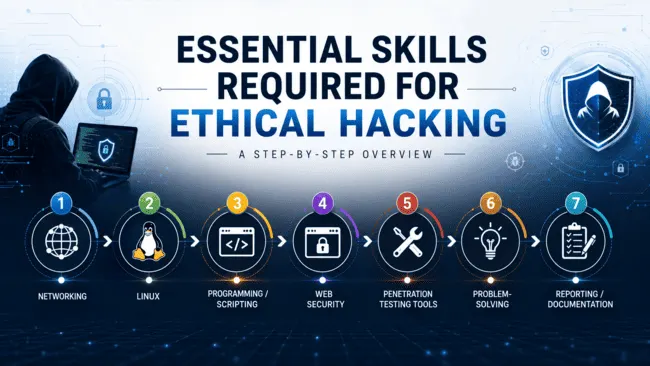 Ethical Hacking
Skills required for ethical hacking include networking, operating systems, web security, scripting, security tools, reporting, and legal awareness.
 Ethical Hacking
Ethical hacking roadmap step by step provides a clear learning path for beginners to build technical skills, practice safely, specialize, and prepare for cybersecurity roles.
 Ethical Hacking
Tools used by ethical hackers help security professionals identify vulnerabilities, test defenses, analyze risks, and strengthen systems.