Ethical Hacking Audit: A Practical Guide to Finding Security Gaps Before They Become Risks

- Published:
- Last Updated:
An ethical hacking audit helps organizations find security gaps before they become serious business risks. It uses authorized testing to uncover vulnerabilities, validate security controls, and guide remediation so teams can fix weaknesses early, improve audit readiness, and strengthen protection across critical systems.
Overview
An ethical hacking audit helps organizations find security gaps before they turn into real business risks. It uses authorized testing methods to check systems, networks, applications, cloud environments, and user access controls for weaknesses that attackers could exploit.
In this guide, you will learn what an ethical hacking audit is, why it matters, how the audit process works, what vulnerabilities it commonly reveals, and how organizations can use audit findings to improve cybersecurity, compliance readiness, and risk management.
LaPorte, Brad. "Preventative Security in the Era of 'Speed to Breach': Why Time to Detection Is a Losing Metric." New York, November 6, 2025.
Key Findings
- Security policies may look complete, but real systems can still have hidden gaps.
- Ethical hacking audits show how attackers may exploit login pages, networks, APIs, cloud assets, or user behavior.
- Findings become more useful when they include severity, evidence, and business impact.
- Regular audits help teams track whether security controls are improving over time.
Recommendations
Organizations planning an ethical hacking audit should:
- Focus first on critical systems, sensitive data, and public-facing assets.
- Define clear testing scope, rules, and approvals.
- Involve security, IT, compliance, and business owners.
- Prioritize findings by business impact and risk level.
- Assign owners, deadlines, and retesting steps for each issue.
- Use audit results to improve controls, awareness, and remediation processes.
What Is an Ethical Hacking Audit and Why Does It Matter?
An ethical hacking audit is an authorized security review that tests systems, applications, networks, cloud environments, and user access controls for weaknesses. It helps organizations find security gaps before attackers, auditors, customers, or regulators discover them.
Unlike a basic checklist review, an ethical hacking audit uses practical testing methods. It checks how security controls behave in real situations. For example, it may test whether login pages are exposed, passwords are weak, APIs are insecure, cloud storage is misconfigured, or users have more access than required.
This helps security teams fix technical issues while giving leadership a clear view of business risk, compliance exposure, and remediation priorities.
Read also: What Is Enumeration in Ethical Hacking?
What Are the Key Steps in an Ethical Hacking Audit?
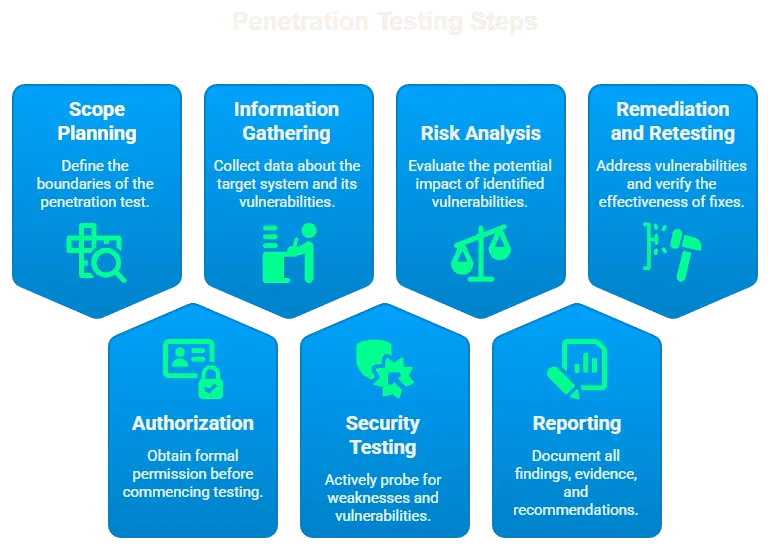
An ethical hacking audit should follow a structured process so testing remains safe, legal, and useful.
Key steps include:
- 1.Scope planning
Decide which systems, applications, networks, users, and environments will be tested. - 2.Authorization
Get written permission before any testing starts. - 3.Information gathering
Review system details, technologies, access points, and possible attack surfaces. - 4.Security testing
Test for vulnerabilities, weak configurations, insecure access, exposed services, and poor security controls. - 5.Risk analysis
Rate each issue based on severity, business impact, exploit possibility, and data sensitivity. - 6.Reporting
Document findings, evidence, risk levels, and recommended fixes. - 7.Remediation and retesting
Fix the issues and test again to confirm that the risk has been reduced.
Flobbe, Amanuel. "Complete Penetration Testing Guide for Businesses." Sunbytes, February 1, 2025.
What are Key Types of Ethical Hacking Audits?
Different audits focus on different parts of the organization's security environment.
The table below breaks down the main audit types:
| Audit Type | What It Checks | Why It Matters |
|---|---|---|
| Network Audit | Firewalls, ports, devices, and services | Finds exposed or weak network points |
| Web Application Audit | Login pages, forms, APIs, and sessions | Detects application-level security gaps |
| Password Audit | Password strength and credential risks | Reduces account compromise risk |
| Cloud Security Audit | Cloud storage, permissions, and configurations | Prevents cloud data exposure |
| Social Engineering Audit | Employee response to phishing or manipulation | Improves security awareness |
- Network Audit: Checks firewalls, ports, and devices to find weak network exposure.
- Web Application Audit: Tests login pages, forms, APIs, and sessions for app-level gaps.
- Password Audit: Reviews password strength and credential risks to reduce account compromise.
- Cloud Security Audit: Checks cloud permissions and configurations to prevent data exposure.
- Social Engineering Audit: Tests employee response to phishing and manipulation attempts.
The right audit type depends on business risk, system criticality, data sensitivity, and compliance needs. For example, an organization handling customer data may prioritize web application and access control testing, while a cloud-based business may focus more on cloud configuration and permission reviews.
Read also: What Are Social Engineering Attacks?
How Is an Ethical Hacking Audit Different from a Cybersecurity Audit?
Cybersecurity Audit
- Reviews the overall security program.
- Checks policies, procedures, governance, and documentation.
- Assesses access rules and compliance readiness.
- Confirms whether security controls are defined and managed properly.
- Gives visibility into governance, compliance, and security maturity.
Ethical Hacking Audit
- Focuses on practical security testing.
- Tests systems, applications, networks, cloud environments, and access points.
- Checks whether security controls work in real-world conditions.
- Identifies exploitable gaps before attackers can use them.
- Provides real-world validation of security risks and remediation needs.
Both are important. A cybersecurity audit gives governance and compliance visibility, while an ethical hacking audit provides real-world validation of security gaps and attack risks.
IBM. "IBM 2026 X-Force Threat Index: AI-Driven Attacks Are Escalating as Basic Security Gaps Leave Enterprises Exposed." IBM Newsroom, February 25, 2026.
Why Do Organizations Conduct Ethical Hacking Audits?
Organizations conduct ethical hacking audits to understand their real security position. These audits help teams move from assumption-based security to evidence-based security.
They are useful for:
- Finding hidden vulnerabilities
- Improving compliance readiness
- Reducing cyberattack risk
- Protecting customer and business data
- Supporting leadership decisions
- Preparing audit evidence
- Improving employee awareness
- Strengthening security controls
For growing companies, Cybersecurity for Small Businesses: What Every Owner Should Know can also help explain why proactive security testing is important.
What Vulnerabilities Do Security Tests Commonly Reveal?
Ethical hacking audits often reveal issues that are missed during daily operations or basic security reviews.
Common findings include:
- Weak or reused passwords
- Missing security patches
- Exposed login pages
- Insecure APIs
- Misconfigured cloud storage
- Excessive user permissions
- Lack of multi-factor authentication
- Open ports and unused services
- Poor session management
- Insecure file uploads
- Outdated software versions
- Phishing-prone employee behavior
Why Are Ethical Hacking Audits Necessary?
Audits are necessary because security risks do not stay the same. As organizations add new systems, users, applications, and cloud tools, new gaps can appear.
Here are the key reasons these audits matter:
- Cyber risks keep changing with new apps, users, vendors, cloud services, and system updates.
- One-time security reviews are not enough to confirm long-term control effectiveness.
- Regular audits help organizations find new weaknesses before they become serious risks.
- They improve security culture by showing teams how attackers may target systems or users.
- Audit findings can support practical training on phishing, weak passwords, unsafe file sharing, and access misuse.
What Should an Ethical Hacking Audit Report Include?
The audit report should be clear enough for both technical teams and business leaders.
It should include:
- Audit scope and objectives
- Testing methods used
- Systems and applications tested
- Summary of findings
- Risk severity levels
- Evidence such as screenshots or logs
- Business impact explanation
- Recommended remediation steps
- Responsible owners
- Remediation timelines
- Retesting results
Conclusion
Ethical hacking audits help organizations move from assuming they are secure to proving where risks exist and what needs to be fixed. By testing systems, controls, and user access in a structured way, teams can reduce exposure, strengthen audit readiness, and make better cybersecurity decisions.
Explore SecuRetain's learning platform and our all courses to build practical knowledge in cybersecurity, compliance, risk management, audit, business continuity, disaster recovery, fraud management, and employee awareness training.
You can also visit our website to explore how SecuRetain helps professionals and organizations strengthen skills, improve awareness, and support continuous learning in a structured and scalable way.
FAQ's
An ethical hacking audit is an authorized security review that tests systems, applications, networks, and access controls to find exploitable weaknesses.
It helps organizations identify security gaps early, reduce cyber risk, and improve audit and compliance readiness.
Penetration testing is one method used in an ethical hacking audit, but an audit may also include password testing, vulnerability assessment, cloud review, and social engineering checks.
It should be performed by authorized cybersecurity professionals with technical skills, legal approval, defined scope, and proper reporting experience.
Organizations should conduct them regularly, especially after major system changes, application launches, cloud migrations, or before important audits.
Build practical cybersecurity skills
Explore SecuRetain courses that help learners understand ethical hacking, cybersecurity controls, audit readiness, and risk-based remediation.
Related reads
Keep exploring
 Cybersecurity
A step-by-step guide to conducting vulnerability assessments safely, from scope and asset discovery to scanning, prioritization, remediation, and reassessment.
 Ethical Hacking
Ethical hackers support security teams by safely testing corporate systems, access controls, applications, users, devices, and security processes under approved scope.
 Cybersecurity
A vulnerability report is a structured security document that explains weaknesses found during ethical hacking or vulnerability assessment.